Most people assume a song has one owner. In Nigerian copyright law it almost never does.
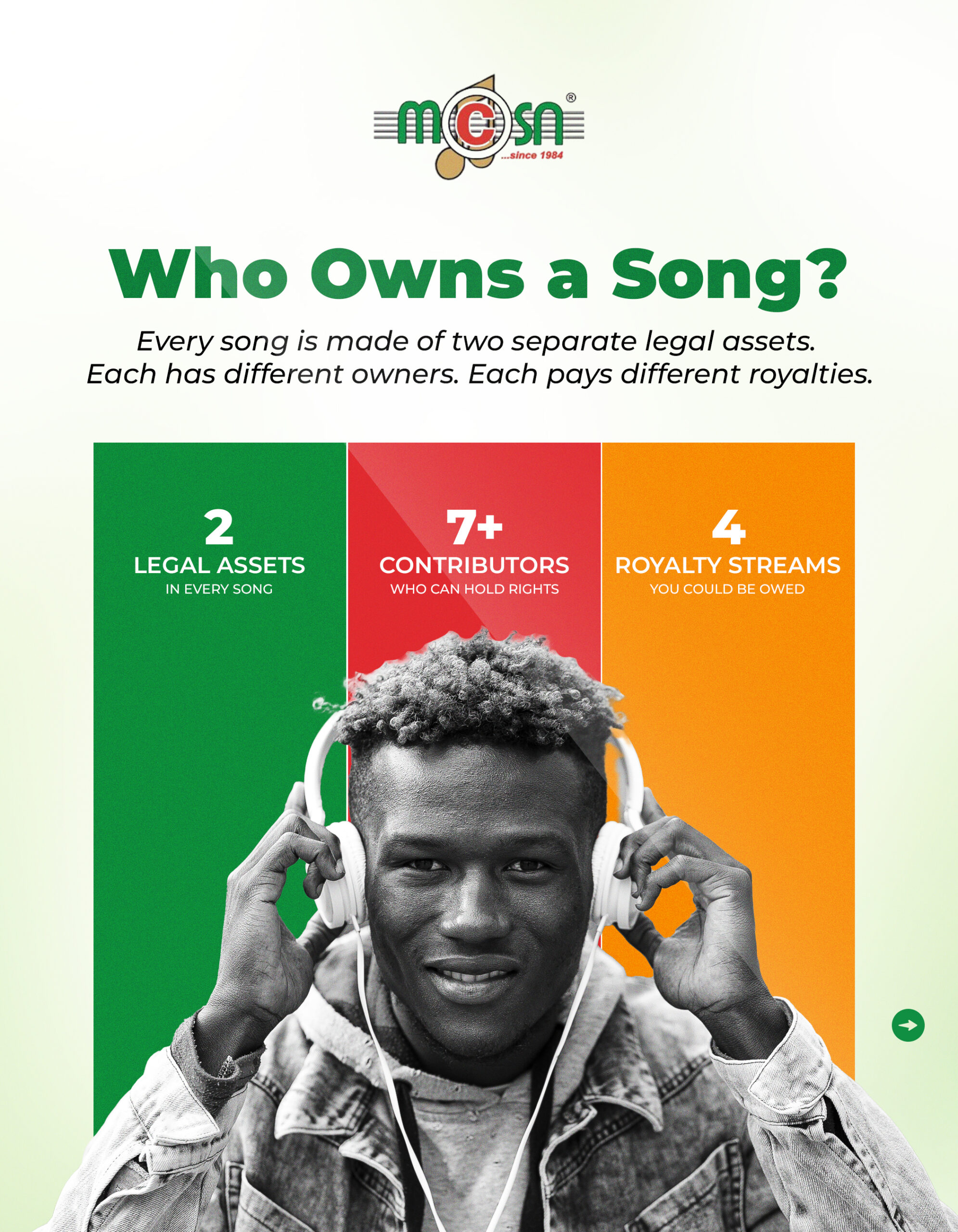
A recorded song contains two separate legal assets: the musical work (the composition) and the sound recording (the master). Each has its own authors, its own owners, and its own royalty streams. Confusing the two is one of the most expensive mistakes a Nigerian creator can make.
This article explains who owns each layer, how the Copyright Act 2022 decides first ownership, how contracts can change that picture, and why accurate registration with MCSN is what turns ownership into payment.
What Does It Mean to Own a Song?
The two Assets inside every Song
Under the Copyright Act 2022, musical works and sound recordings are listed as separate categories of protected work. They can be owned, licensed, assigned and inherited independently.
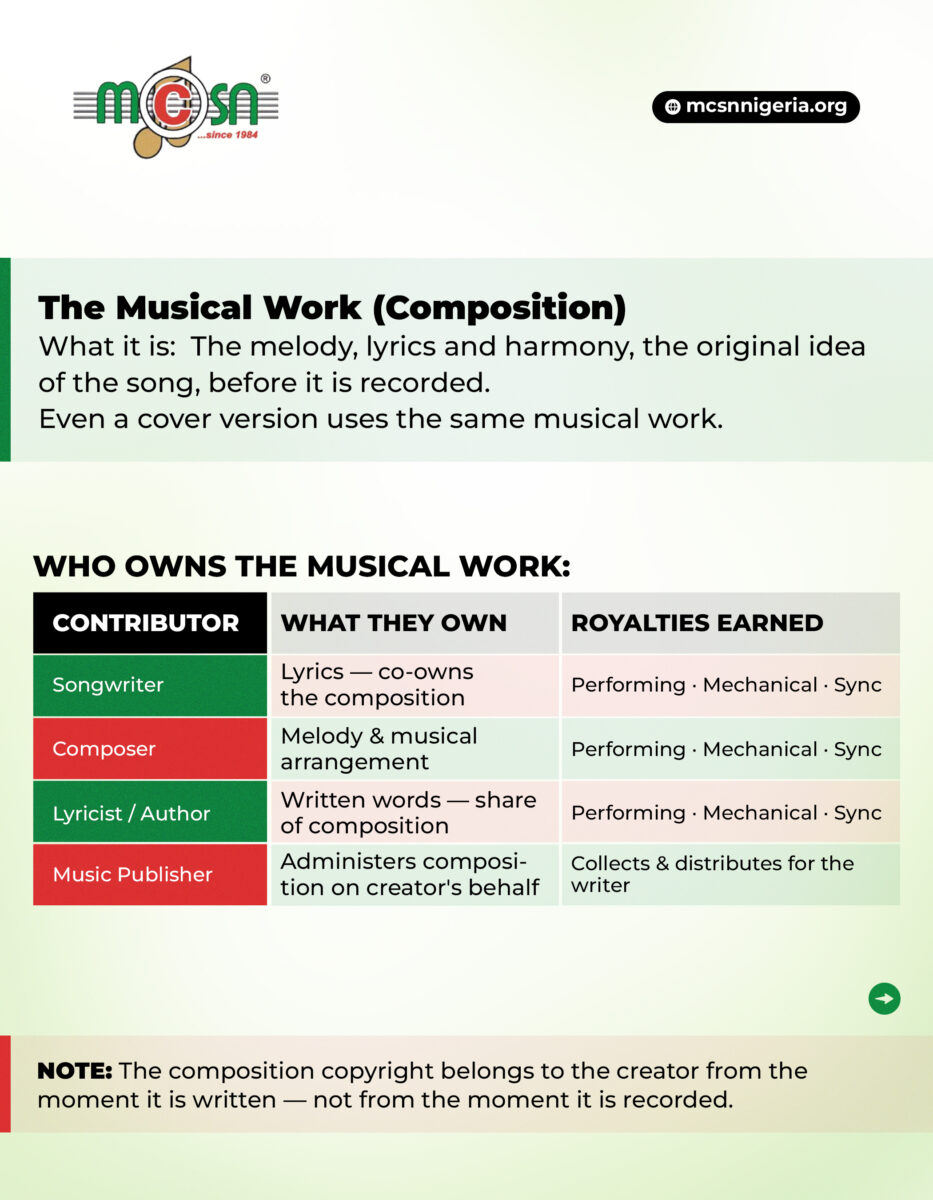
The musical work (composition) is the song in the abstract: melody, lyrics, harmony, structure and arrangement. It exists as soon as it is created and fixed in a definite form, whether written down, recorded as a demo or saved as a file. Ten different artists can record the same composition. There is still only one musical work.
The sound recording (master) is one specific recorded version of that composition. If three artists record the same song, there are three separate sound recordings, each with its own copyright.
A useful way to keep them apart: the composition is the blueprint. The sound recording is the finished recording made from that blueprint.
MCSN administers rights in both categories. That is why a creator who wrote and recorded their own material can collect on both sides from a single membership, provided both sides are properly registered.
Who Owns the Musical Composition?
Section 28 of the Copyright Act 2022 says copyright initially vests in the author, unless an agreement provides otherwise.
For a musical work, the authors are the people who created it:
- Composers own the melody, harmony and musical structure they created.
- Songwriters own the song as a whole, in the proportion they contributed.
- Lyricists and authors own the words. Lyrics are part of the composition. A person who wrote only the words still holds a genuine share.
A publisher does not usually create the composition. A publisher comes to own or administer a share through an assignment or an administration agreement with the writer.
Most Nigerian songs have more than one writer. Where contributions merge into an inseparable whole, those people are joint authors and co-owners. Their shares should be agreed in writing. An undocumented split is not a small administrative problem. It is the start of a dispute.
Being the featured artist does not automatically make you the owner of the composition. If another person wrote the song and you recorded it, that writer still owns the musical work unless they assigned or licensed those rights to you.
Who Owns the Sound Recording?
This is the side that varies most, and where handshake understandings cause the most damage.
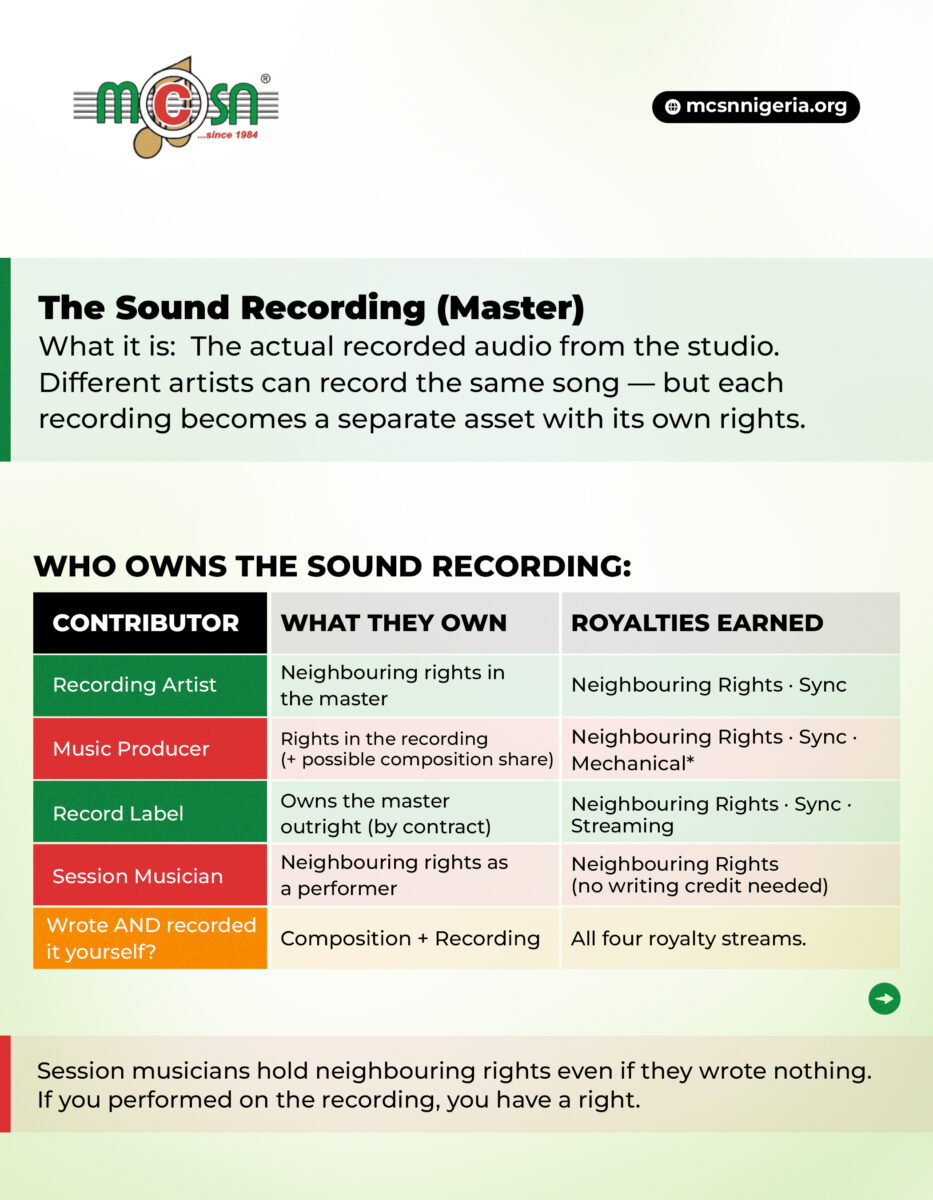
The Act treats the author of a sound recording as the person by whom the arrangements for making the recording were made. In practice that is often the producer or the person or company that organised and financed the session. A contract can, and frequently does, assign that copyright to a label or another party.
Separately from copyright in the master itself, performers hold neighbouring rights in the recording. A lead artist, featured artist, backing vocalist or session musician who performed on the track has rights connected to that performance, even if they wrote nothing and own no share of the master.
Typical positions, subject always to contract:
- An independent artist who wrote, performed and paid for the session often owns both the composition and the master.
- A traditional recording agreement often assigns ownership of the master to the label.
- A producer typically holds rights in the recording they produced. They hold a share of the composition only if they also contributed to the writing and that contribution is documented.
- A session musician holds neighbouring rights in the specific recording they performed on.
Do not assume the name on the streaming page is the owner of either asset. Credits show contribution. Contracts and the Act determine ownership.
How contracts change Song Ownership
A handful of assumptions account for most of the disputes and most of the lost income MCSN sees among Nigerian creators.
Assuming the performer owns everything: Being the artist whose voice the public knows does not by itself give you ownership of the composition. If you did not write the song, the songwriter’s share exists whether or not it was ever discussed at the time.
Assuming a producer who built the beat owns nothing, or owns everything: Both extremes are usually wrong. A producer typically owns rights in the recording. A composition share depends entirely on whether they contributed to the melody or structure and whether that was documented.
Assuming a label deal takes every right: Recording agreements very often assign the master to the label. They rarely, on their own, touch the songwriter’s composition rights unless the agreement specifically says so. An artist can retain their publishing while a label controls the recording, and both statements can be true about the same song at once.
Leaving a contribution undocumented until the song starts earning: Splits agreed in conversation are remembered differently by different people, usually in their own favour, usually months after the fact, and usually once real money is involved.
Assuming that writing and recording it yourself removes anyone else’s claim: This is true, but only if nobody else contributed creatively and nothing was ever assigned away. The moment a co-writer, a producer with a documented share, or a session performer becomes involved, ownership is shared unless an agreement says otherwise.
What Happens When You Cover Someone Else’s Song?
Ownership is not the same as collecting royalties
In Nigeria, copyright exists the moment you create something. You do not need to register with anyone to own it. But owning a right and collecting money from that right are two different things, and this is where a real number of Nigerian creators lose income they are legally entitled to.
MCSN can only pay a royalty on a work it can identify. That means matching usage data, radio logs, streaming reports, venue licence returns, against a registered work and a clear set of ownership splits. A song that legally belongs to you but was never submitted, or was submitted with incomplete or conflicting ownership details, cannot be matched to anything. The royalties it generates still exist. They simply have no verified owner to be paid to.
This is a separate question from notifying a work with the Nigerian Copyright Commission through its voluntary eRegistration system. That creates useful evidence of your claim if ownership is ever disputed, but it has nothing to do with collecting royalties. Registering with MCSN is what makes collection possible. The two systems solve different problems, and neither one substitutes for the other.
Also, a distributor statement is not the whole picture either. A distributor typically collects for exploitation of the recording. Composition royalties and neighbouring rights collected by a CMO are a different stream.
Split Sheets: Settling Ownership Before It Becomes a Dispute
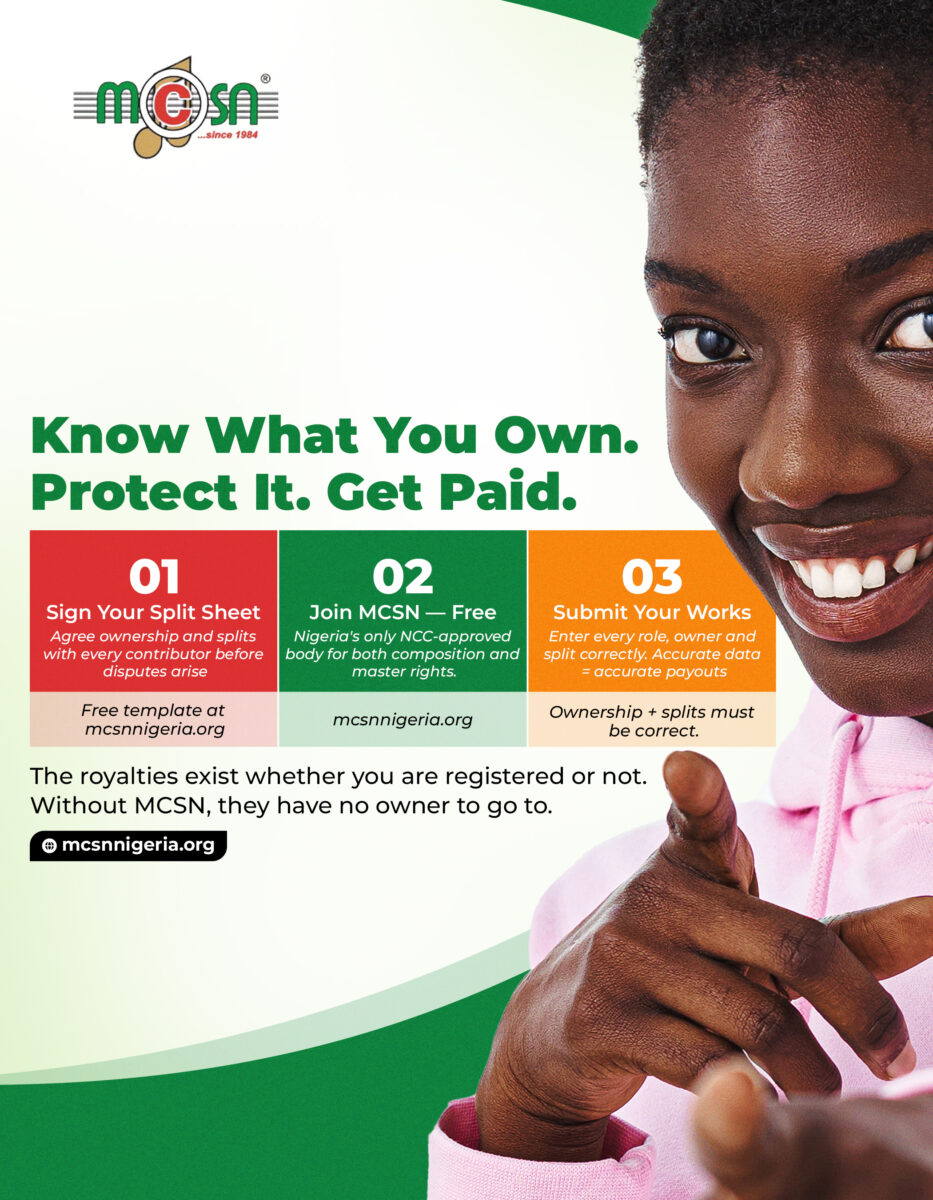
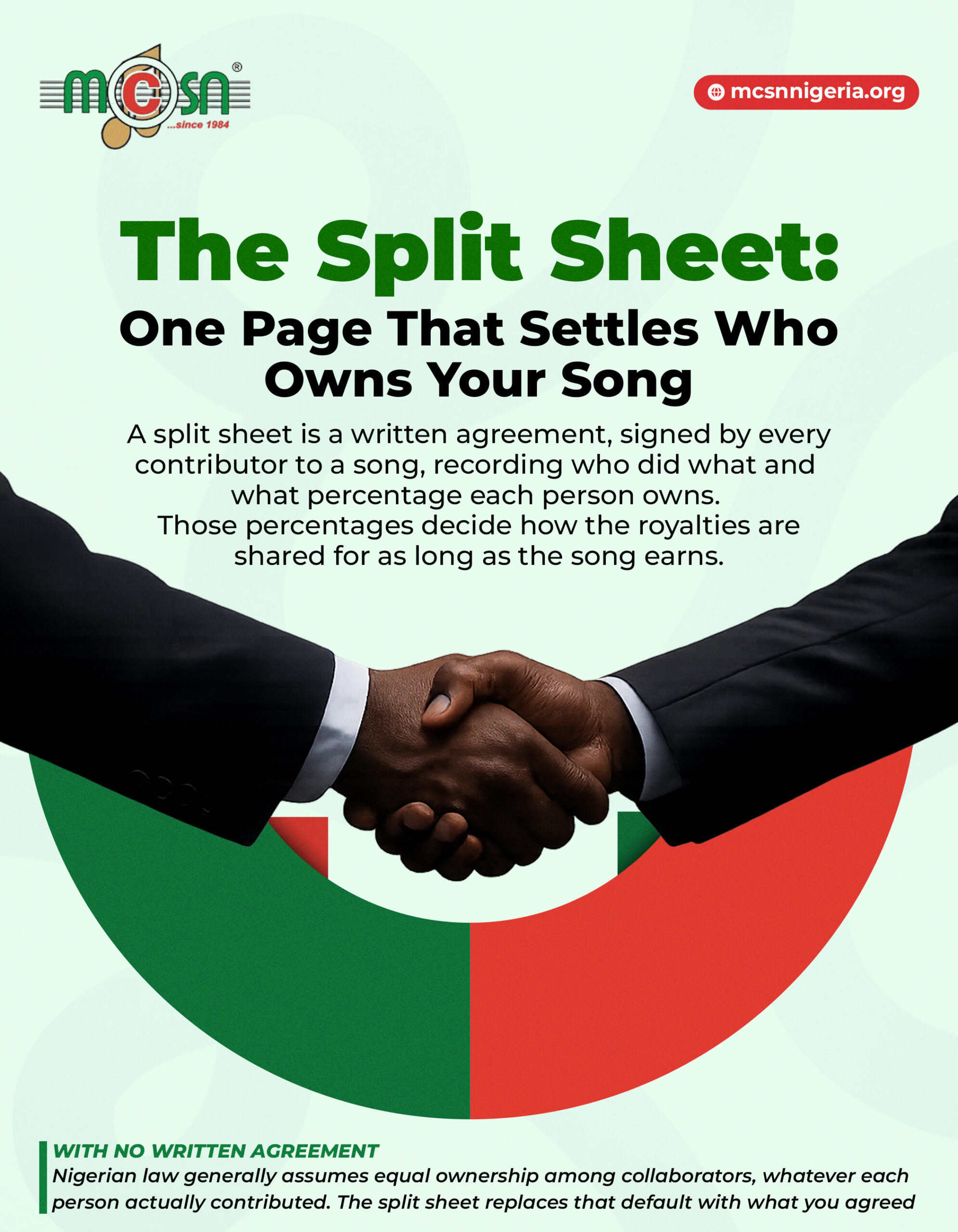
A split sheet is a short written record, signed by every contributor to a song, of who did what and what percentage of ownership each person holds. It is the single most effective tool for avoiding an ownership dispute later, because it settles the question while everyone remembers accurately who contributed what and is still on good terms about it.
A usable split sheet records, at minimum, every contributor’s full name and role, whether their share applies to the composition, the master, or both, the agreed percentage each person holds, and the date and signatures of everyone involved.
Sign it before release, not after a dispute has already started. MCSN provides a split sheet template covering both composition and master ownership.
Who Owns What: A Role by Role Summary
- Songwriter or composer: Own the composition, in the proportion they contributed. No automatic claim over any specific recording of it.
- Author or lyricist: Own a share of the composition equal in kind to any other writing contribution, whether that share came from words or music.
- Publisher: Owns or administers a share of the composition, by assignment or agreement with the writer, not by default.
- Recording artist or performer: Holds performer’s rights in the specific master they performed on. Only holds composition rights if they also wrote the song.
- Session musician: Holds performer’s rights in the master purely for performing on it, even with no writing credit and no ownership stake.
- Producer: Typically holds rights in the recording. A composition share only where that contribution was agreed and documented in writing.
- Record label: Frequently owns the master outright under a recording agreement. Rarely owns the underlying composition.
- Wrote it, performed it and financed the recording yourself: You hold both assets outright, and one MCSN membership, registered in every role you actually hold, is what lets you collect on all of it.
One radio play or one stream can use both assets at once. The writers earn from the composition. The performers, producer and master owner earn from the recording. If you hold both roles and have registered both, you can collect both.
What MCSN needs from you
When you submit a work, you are telling the system who owns the composition and in what shares, who owns or controls the sound recording, and who performed on it. Accurate information allows MCSN to collect performing and mechanical royalties on the composition, neighbouring rights on the recording, and to facilitate sync clearances for both sides.
MCSN does not become the creator of your song by administering it. Ownership answers who holds the right. Administration answers who is licensed to manage specified rights at scale.
- For every track, identify whether you hold composition rights, recording or neighbouring rights, or both.
- Agree splits in writing before release.
- Register with MCSN in every role you hold.
- Submit works with complete contributor, role and percentage information, plus identifiers such as ISRC and ISWC where you have them.
- Keep contracts, bank details and ownership changes up to date.