Most hits are built by more than one person; a composer shapes the melody, a lyricist writes the words, a producer builds the beat, an arranger adds the horn line, a performer brings the record to life, and a label puts it into the world. That collaboration is the strength of the industry. It is also where the money problems start, because when a song succeeds, every one of those contributors has a claim, and if nothing was written down, nobody can prove what that claim is.
The document that prevents this is the split sheet. It takes minutes to complete and it can settle, in advance, disputes that would otherwise run for decades. This guide explains what a split sheet is, what Nigerian law says about ownership when you do not have one, how splits are typically calculated on both sides of a song, and how to put one in place before your next release.
What Is a Split Sheet?
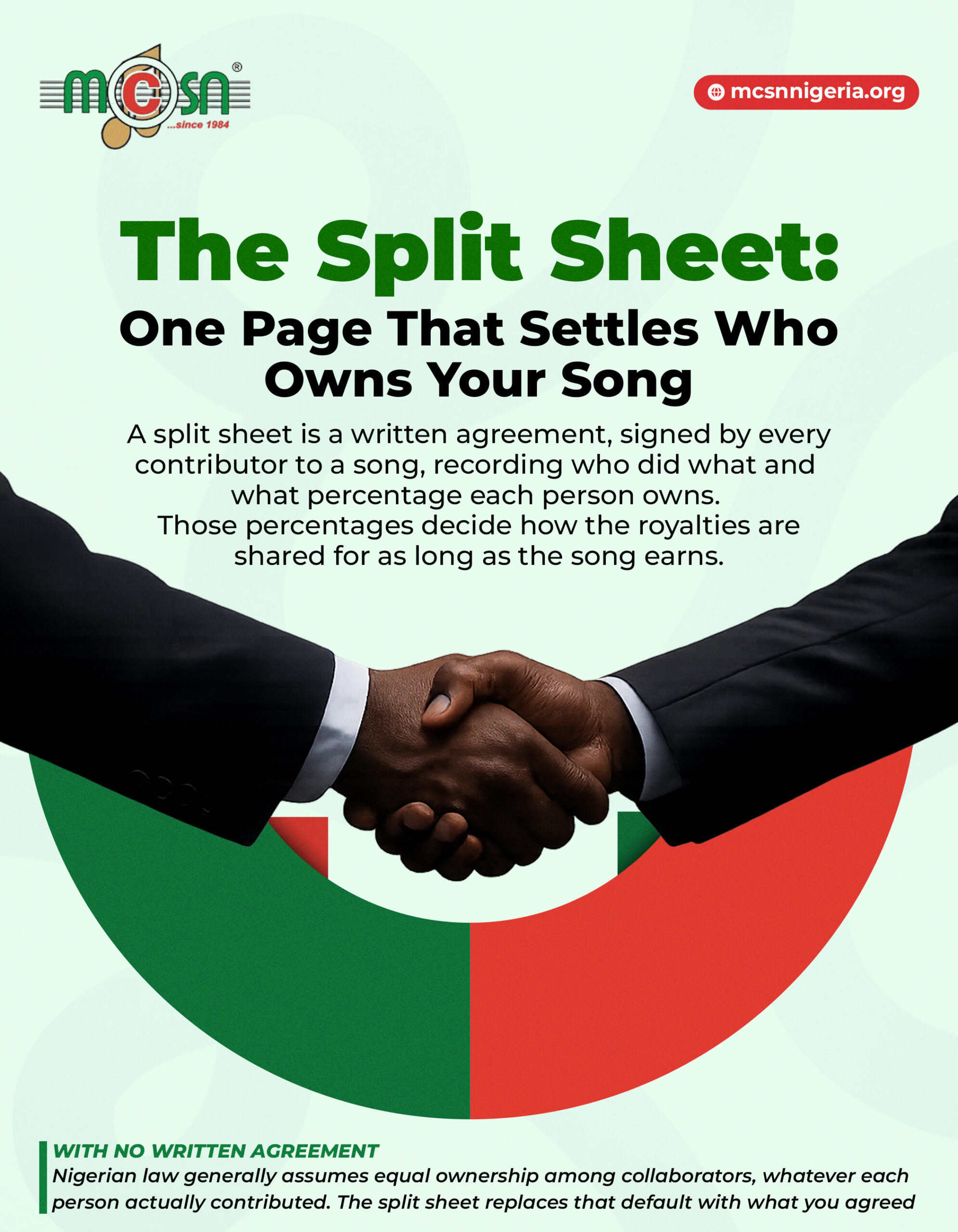
A split sheet is a written agreement, signed by everyone who contributed to a song, that records who did what and what percentage of the song each person owns. The percentages on the sheet determine how royalties are shared when the song earns money from streaming, broadcast, public performance, or licensing. Once every contributor signs, the split sheet becomes binding evidence of the agreement.
It is not a copyright registration and it does not protect the song from infringement. What it does is remove ambiguity. When a collecting society, publisher, distributor, or music supervisor needs to know who to pay, the split sheet is the answer.
Think of it as the recipe card for your track. It records exactly what went into the song and who supplied it, so that when the money comes in, there is nothing left to argue about.
Why the Split Sheets exists: the problem it solves
Nigerian music has no shortage of stories about this going wrong. A beat gets sent over WhatsApp with a verbal “we go split am 50-50.” A feature gets added the night before release with nothing in writing. A song blows up, and three months later there is a disagreement that ends up costing far more in legal fees, damaged relationships and delayed royalties than the five minutes it would have taken to write the split down at the time.
A split sheet exists to close that gap before it opens.
- It avoids disputes: Ownership is documented at the moment everyone agreed, not reconstructed from memory after a hit.
- It clarifies roles: Lyricist, composer, producer, topliner, featured performer, each role is named, not assumed.
- It ensures fair compensation: Everyone gets paid the share they actually agreed to, not the share someone remembers agreeing to.
- It speeds up royalty collection: For collective management, a split sheet is the source document that tells us exactly how to divide what a song earns.
- It protects you legally: A signed split sheet is not a full contract, but it is strong evidence of what was agreed, and that matters enormously if a dispute ever reaches a lawyer or a court.
- It makes you look professional: Labels, publishers and sync licensors move faster with an artist who already has clean paperwork.
- It protects you from later claims: If someone reappears years afterward claiming a stake they never had, a signed split sheet is your answer.
Under the Copyright Act 2022, this documentation matters legally as well as practically. Where a work has more than one owner, a licence or assignment granted by just one of them takes effect as if granted by all of them, with payment shared out afterward. An undocumented split isn’t just messy bookkeeping. It’s a real gap another co-owner could act through without your knowledge.
Blackface, a founding member of Plantashun Boiz, has maintained since 2004 that he co-wrote African Queen with 2Baba under an agreed fifty-fifty split that was never honoured. The official copyright registration listed only 2Baba as the songwriter. 2Baba acknowledged the collaboration but said he wrote most of the song.
With no signed document recording what was agreed in the room, the dispute produced years of public conflict, legal threats, and broken trust. One signed page would have settled it.
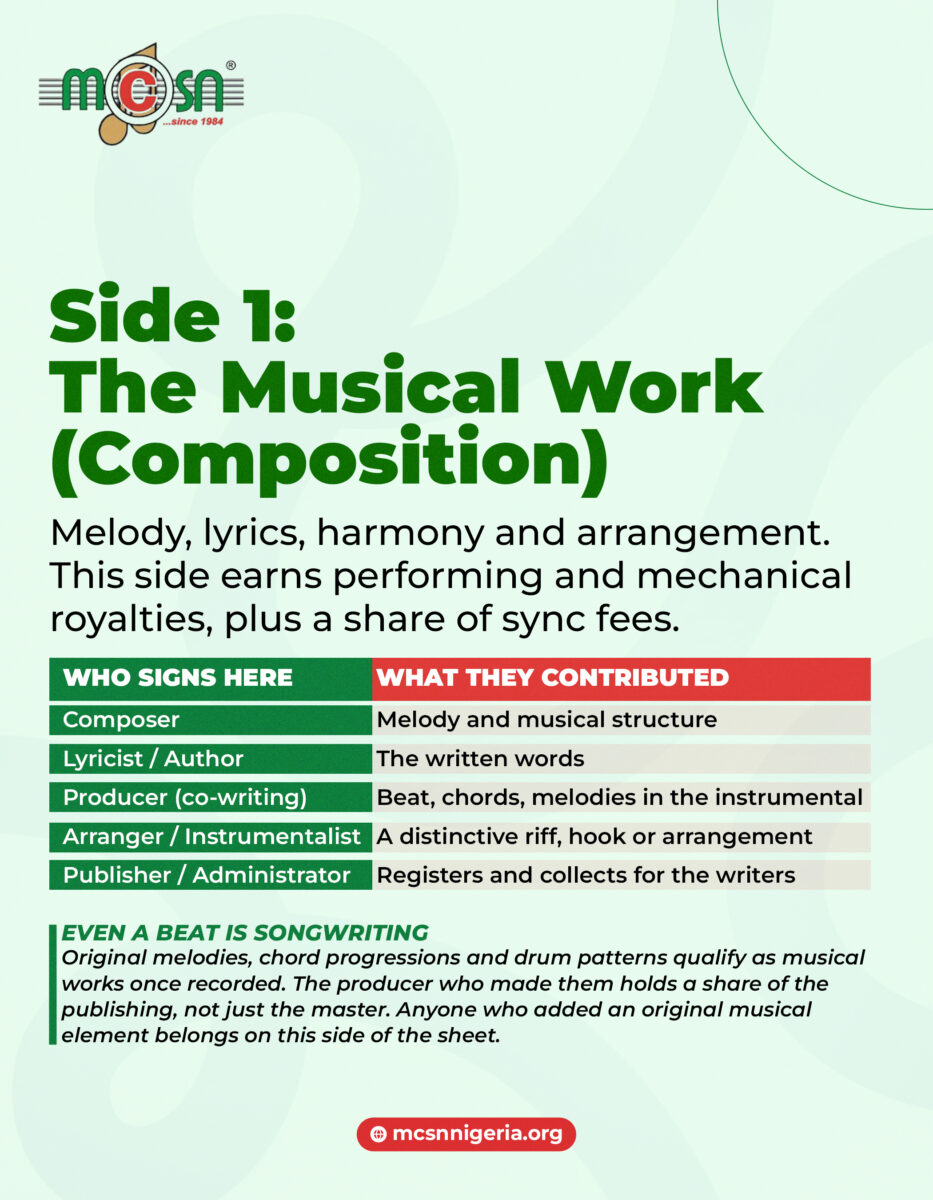
Every Song has two Sides, your Split Sheets should cover both
Under the Nigerian Copyright Act 2022, a recorded song contains two separate copyrights:
- The Musical Work (the composition): The melody, lyrics, harmony, and arrangement. Musical works are protected under Section 2(1)(a) of the Act. This side belongs to the composer, lyricist, songwriter, arranger, and any producer who contributed original musical elements. It earns performing and mechanical royalties, and a share of sync fees.
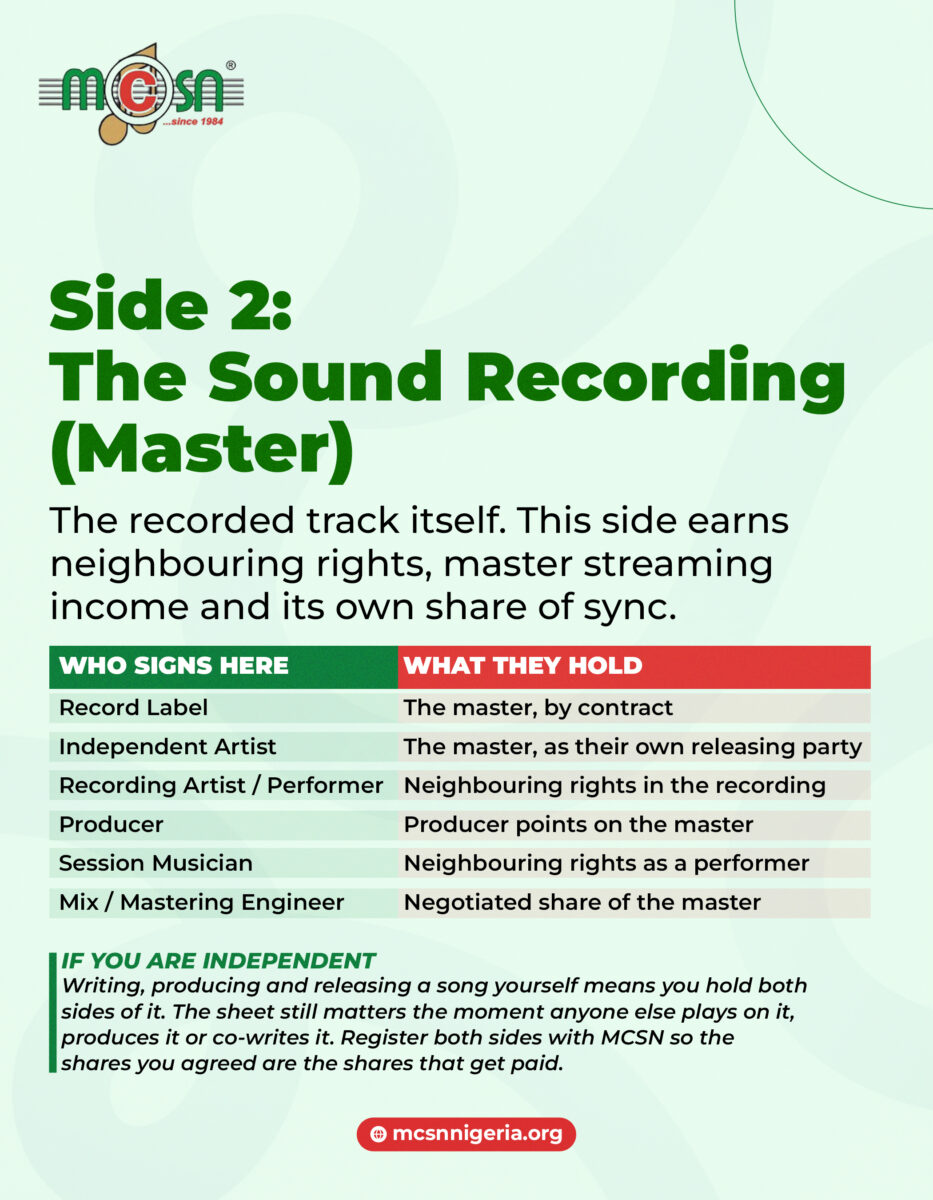
- The Sound Recording (the master). The specific recorded version of the track, protected under Section 2(1)(e). Section 108 defines the author of a sound recording as the person who made the arrangements for the recording, which in practice is usually the record label, or the artist on an independent release. This side earns neighbouring rights royalties, streaming master income, and its own share of sync fees.
Most split sheet templates in circulation only deal with the composition. That leaves the entire sound recording side, including producer points, engineer shares, and performer rights, undocumented. A complete split sheet for the Nigerian market should record the splits on both sides: performing and mechanical rights on the composition, neighbouring rights on the recording, and sync on both.
What the Law Says When You Have No Split Sheet
The Nigerian Copyright Act 2022 recognises joint authorship. Section 5 provides that a work produced by the collaboration of two or more authors, where the contributions are not separable, is a work of joint authorship. Section 30(5) treats co-owners of copyright as partners in the right for the purposes of assignment, licensing, and royalty collection. Section 28(1) vests first ownership of copyright in the author, except where the parties have agreed otherwise.
Here is the practical consequence: where contributors have no written agreement, the law generally assumes equal ownership. The producer who built eighty percent of the record and the friend who suggested one line of the hook can end up presumed equal co-owners. A split sheet is the written agreement that replaces that default with what the contributors actually intended.
No paperwork means the default applies; If you believe your contribution is worth more than an equal share, the only way to secure that is in writing, signed, before release.
Who Needs to Be on the Split Sheet
Anyone who added an original, copyrightable element to the song or the recording should appear on the sheet. For a typical Nigerian release, that includes:
| CONTRIBUTOR | SIDE OF THE SONG | WHAT THEY TYPICALLY HOLD |
|---|---|---|
| Composer | Musical Work | Share of the composition for melody and musical structure |
| Lyricist / Author | Musical Work | Share of the composition for the written words |
| Songwriter | Musical Work | Combined melody and lyric contribution |
| Arranger | Musical Work | Share where the arrangement adds original musical elements |
| Producer | Both sides | Composition share where they co-wrote, plus producer points on the master |
| Performer / Recording Artist | Sound Recording | Neighbouring rights in the master, plus master income by contract |
| Session Musician | Sound Recording | Neighbouring rights as a performer, with no writing credit needed |
| Record Label | Sound Recording | Master ownership by contract, under Section 108 arrangements |
| Publisher / Administrator | Musical Work | Administers the composition and collects on the writers’ behalf |
A saxophone hook, a guitar riff, or a melody tweak qualifies for copyright once it is original and recorded, under Section 2(2) of the Act. Contributors of this kind typically receive between zero and ten percent of the composition, depending on how central the element is to the song.
How Splits Are Typically Calculated
On the composition side
- One lyricist and one producer-composer: the common starting point is fifty-fifty, half for the words and half for the music.
- Two co-producers and a lyricist: the composer half is shared, so each producer takes twenty-five percent and the lyricist keeps fifty.
- Additional contributors, such as an instrumentalist who adds a distinctive riff: usually between zero and ten percent, negotiated on impact.
- Equal splits among all writers are the simplest route and the safest way to preserve working relationships. Whatever you choose, the total must equal one hundred percent.
On the sound recording side
- The label, or the independent artist, typically controls the master income as the party that arranged the recording.
- Producers commonly negotiate producer points of two to ten percent on a label release, and up to twenty-five percent on an independent release where their contribution defines the sound.
- Mixing and mastering engineers may receive around one percent, depending on their standing and contribution.
- Session musicians and featured performers hold neighbouring rights in the recording, which should be recorded on the sheet even where no master percentage is negotiated.
What the MCSN Split Sheets Template Contains
The MCSN Split Sheet Template is designed to capture everything you need to formalize song ownership and royalty shares, including:
- Song details: title, creation date, release date, and ISRC and ISWC codes where available.
- Every contributor’s legal name (not stage name), role, contact information, and MCSN membership ID where applicable.
- Performing and mechanical rights splits on the composition, totalling one hundred percent.
- Neighbouring rights splits on the sound recording, including producer points and engineer shares.
- Publisher or publishing administrator details, so royalties are registered and routed correctly.
- Signature and date from every contributor. An unsigned or undated sheet is an invitation to dispute, as the Water case showed.
When to Sign the Split Sheets
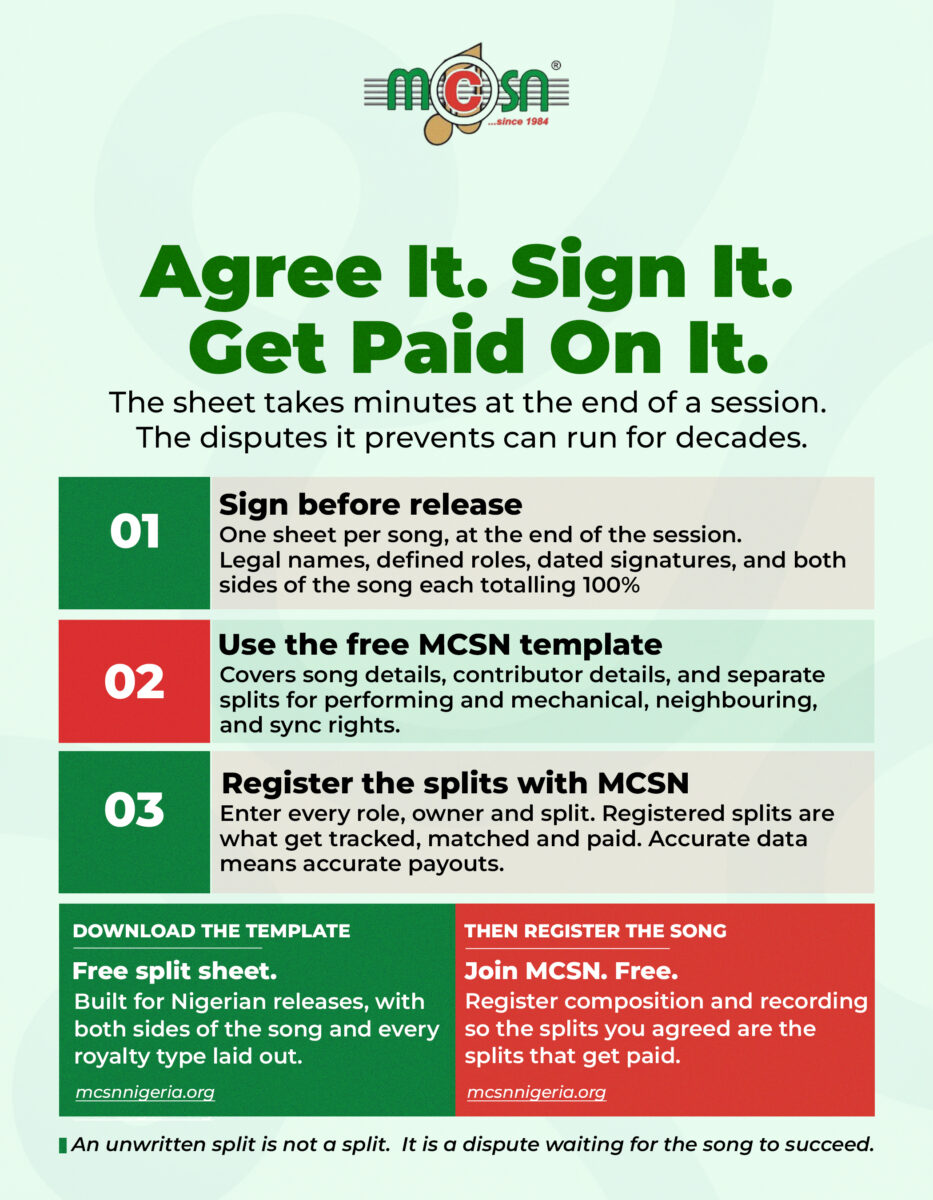
Sign the split sheet at the end of the session, or as soon as the song is finished, and always before release. This is when contributions are fresh, memories agree, and no money is on the table yet. Waiting until a song gains traction invites revisionism, and a dispute lodged after release can freeze royalty payments for everyone until it is resolved. Treat the split sheet like saving your session files: a routine part of finishing a song, one sheet per song, every time.
Common Mistakes to Avoid
| MISTAKE | WHY IT COSTS YOU |
|---|---|
| “We will figure it out later” | Later arrives with money attached. Agreements get harder, not easier, once a song earns. |
| Using stage names | Royalty systems and enforceable agreements require legal names. Stage names can delay or misroute payments. |
| Leaving out minor contributors | Hook writers and instrumentalists hold real shares. Omitting them creates claims later. |
| Covering only the composition | The sound recording side, including producer points and neighbouring rights, goes undocumented. |
| Missing CMO or publisher details | Without society and administrator information, royalties cannot be tracked and routed correctly. |
| Relying on friendship | Verbal promises rarely survive success. Writing it down protects the relationship as much as the money. |
| Not updating after changes | A remix, new verse, or added contributor changes the splits. Update the sheet immediately. |
From Signed Sheet to Paid Royalties
A split sheet by itself doesn’t pay you. It’s the record that makes sure the money that is owed to you actually reaches you correctly once it starts moving. To close that loop:
- Join MCSN, if you haven’t already, as the collective management organisation approved to license, monitor and distribute royalties for musical works and sound recordings in Nigeria.
- Submit your works, with the split sheet as your supporting documentation for how ownership is divided.
- Let us track and collect, from radio, streaming, live performance, broadcast and more.
- Get paid according to the splits you documented, cleanly and without a delay caused by an unclear or missing record.
A split sheet without a CMO membership behind it protects you in a dispute. A split sheet with a CMO membership behind it actually gets you paid.
MCSN provides a free split sheet template built for the Nigerian market, covering song details, contributor details, and separate split tables for performing and mechanical rights, neighbouring rights, and sync. It is aligned with MCSN’s distribution system, so what you sign in the studio is what gets paid out.
The five minutes it takes to fill out a split sheet at the end of a session is the cheapest insurance policy in the music business. It costs nothing, requires no lawyer, and prevents the exact argument that has ended more than a few Nigerian creative partnerships.