The Copyright Act 2022 was signed into law on 17 March 2023, repealing the Copyright Act, Cap C28, Laws of the Federation of Nigeria 2004. It runs to 109 sections across 12 parts, and for the first time in Nigerian history, it gives performers and producers of sound recordings a right to be paid when their recordings are broadcast.
This guide explains the Nigerian Copyright Act 2022 in practical terms, with particular attention to music creators, copyright owners, businesses that use music and the role of the Musical Copyright Society Nigeria (MCSN).
What Is the Nigerian Copyright Act?
The Copyright Act 2022 is the main Nigerian law governing copyright and related rights. It protects qualifying creative works and gives copyright owners legal rights over specified ways those works can be used.
The Act also establishes rules dealing with copyright administration, enforcement, online infringement, performers’ rights and collective management organisations.
The Copyright Act protects six main categories of works:
- Literary works
- Musical works
- Artistic works
- Audiovisual works
- Sound recordings
- Broadcasts
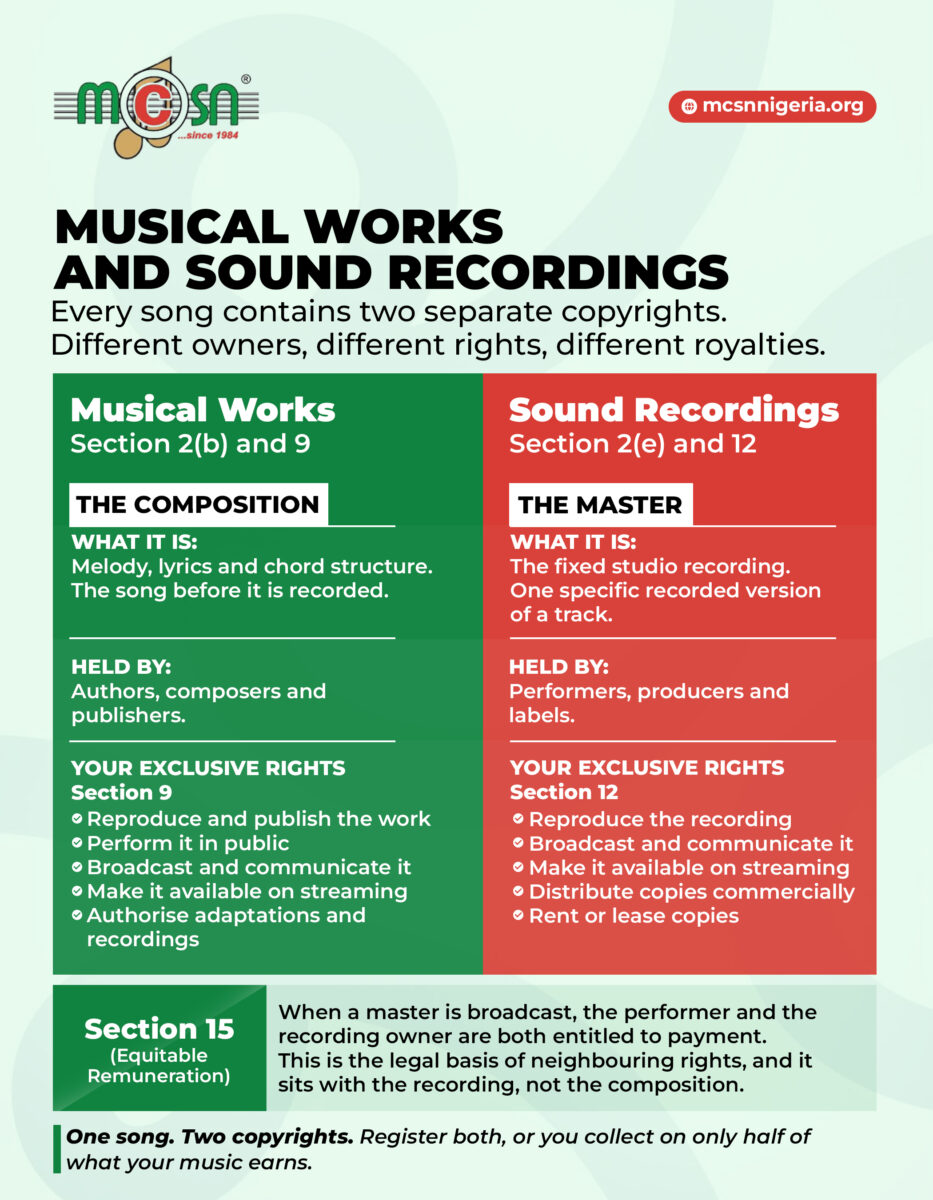
For the music industry, two categories are particularly important: musical works and sound recordings. Understanding the difference between them is essential because they can have different creators, owners and revenue streams.
Objectives, Scope and Subsistence of Copyright
The Act states its own purpose: to protect the rights of authors so they receive just rewards and recognition, to provide exceptions that keep creative works accessible, to bring Nigeria into line with international copyright treaties, and to strengthen the Nigerian Copyright Commission’s capacity to regulate, administer and enforce the law. Everything that follows is that objective in operation.
Works eligible for copyright
Six categories qualify: literary works, musical works, artistic works, audiovisual works, sound recordings, and broadcasts. For music, this is where the foundational split lives. A musical work is the composition. A sound recording is the specific recorded version of it. They are separate categories, protected separately, and a released song contains one of each.
Section 2(2) sets two conditions a literary, musical or artistic work must meet: some real effort must have gone into making it original, and it must be fixed in a medium from which it can be perceived, reproduced or communicated, whether that is a phone recording, a written lead sheet, or a finished master.
For music, a released song normally contains two separate copyright works:
The musical work: the composition, melody, lyrics, structure and other original musical expression. This usually belongs to the songwriter, composer or lyricist.
The sound recording: the specific recorded version, often called the master. This can belong to the artist, producer or label, depending on the contract.
Section 2(3) confirms protection does not depend on the quality of the work or the purpose it was made for. A rough freestyle recorded on a phone qualifies exactly as much as a fully mixed and mastered single.
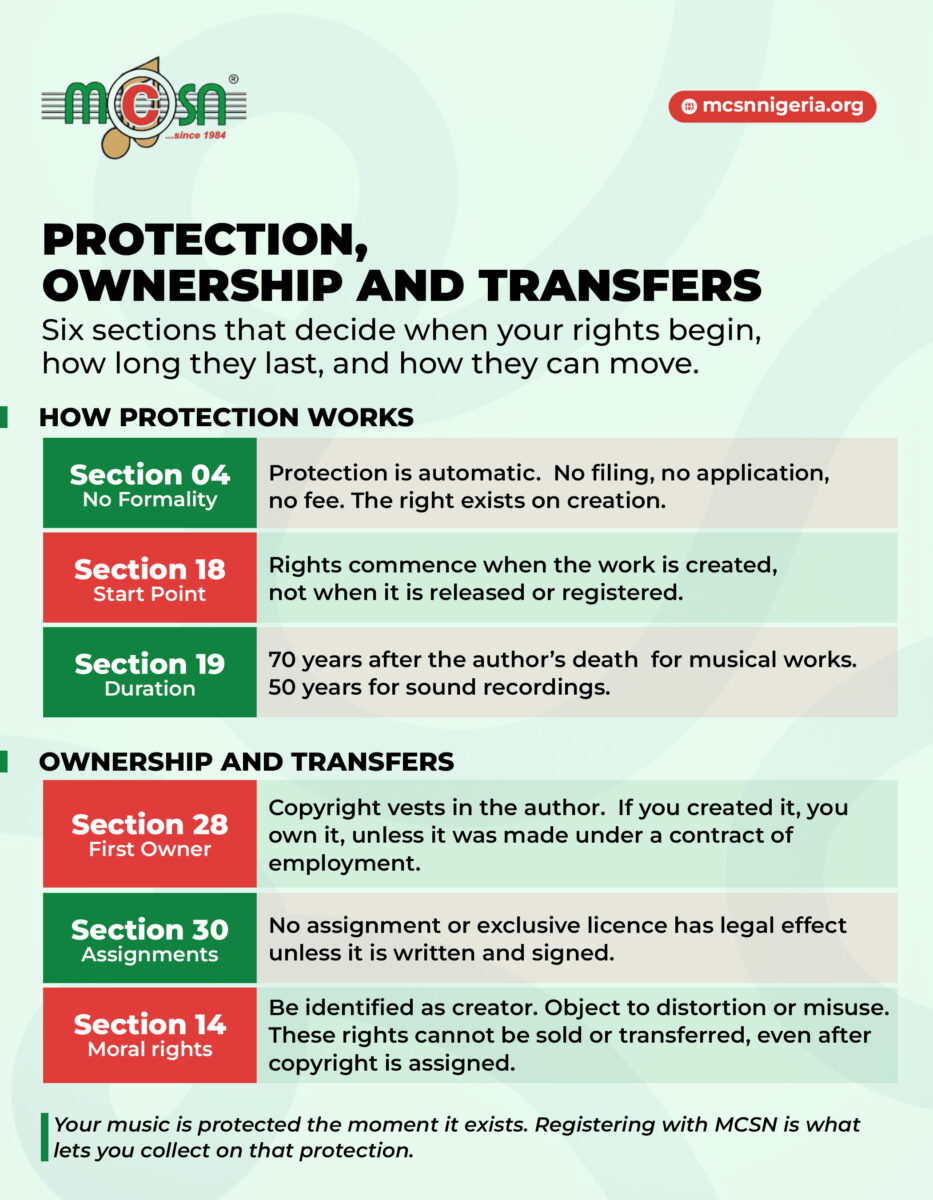
Copyright requires no formality. You do not apply for it, register it, or pay for it before it exists. It arises automatically once the conditions are met.
Ideas, procedures, methods, concepts and mere data are not protected, only their fixed expression. A melody in your head is not protected. The same melody recorded is. This is why co-writers should record sessions and keep drafts; the idea alone gives you nothing to point to later.
What each category of copyright owner actually controls
This is where the Act sets out the bundle of exclusive rights attached to each type of work. Section 9 covers musical (and literary) works. The owner has the exclusive right to reproduce the work, publish it, perform it in public, translate it, turn it into an audiovisual work, distribute it commercially, broadcast it, communicate it to the public, make it available online by wire or wireless means so the public can access it whenever they choose, and adapt it.
That last point covers remixes, covers, samples, translations and interpolations. Nobody can do any of this without the owner’s permission.
Section 12 covers sound recordings specifically: the exclusive right to reproduce the recording, broadcast it, communicate it to the public, make it available online, and distribute copies commercially by sale, rental or lease. Section 10 covers artistic works (album art, for instance), Section 11 covers audiovisual works, and Section 13 covers broadcasts, including a broadcaster’s own right over its transmission.
For a musician, owning a composition and owning a recording are two separate bundles of legal control, and each carries its own list of things nobody else may do without your permission.
Rights in a musical work
Subject to the exceptions in Part II, the owner of a musical work has the exclusive right to:
- reproduce the work
- publish it
- perform it in public
- translate it
- make an audiovisual work or a record of it
- distribute copies for commercial purposes, if that distribution has not already been authorised
- broadcast it
- communicate it to the public
- make it available on demand by wire or wireless means
- adapt it
- do any of those acts in relation to a translation or adaptation
The “making available” right is the statutory language for on-demand streaming. Nobody may do any of the above with your composition without permission, and, in most commercial cases, without paying.
Rights in a sound recording
The owner of a sound recording has the exclusive right to reproduce it, broadcast it, communicate it to the public, make it available on demand, and distribute copies commercially, including by rental, lease or hire.
These rights sit beside the composition rights. A radio play, a stream or a club set can implicate both.
Author’s moral rights
Separate from your economic rights, you have the right to be identified as the author of your work, and the right to object to any distortion, mutilation or modification that would harm your honour or reputation. Section 14(2) adds the right to object to a work being falsely attributed to you. These rights cannot be transferred while you are alive; on death, they pass by will or by law. They last for as long as the copyright itself lasts.
Right to remuneration for broadcasting of sound recordings
This is the single most consequential provision in the Act for Nigerian musicians, and the one the old 1988 law never contained. Where a sound recording is published for commercial purposes, the performer and the owner of copyright in that recording are entitled to equitable remuneration whenever it is broadcast. The person using the recording pays.
Section 15(3) says the amount is agreed between users and rights owners or their representatives, and where they cannot agree, the Nigerian Copyright Commission decides. Section 15(8) gives rights owners the right to inspect the logs, statements and information relating to the broadcast.
This is the legal foundation of neighbouring rights royalties in Nigeria. Before this section existed, a song could dominate radio for a year and the performer, the session players and the label would see nothing from the broadcast itself. Section 15 changed that.
Broadcasting of works incorporated in an audio-visual work
Where a composition owner authorises a work to be included in an audiovisual work (a film soundtrack, for instance), and that audiovisual work is later broadcast, the owner is deemed to have authorised the broadcast, but is entitled to fair compensation from the broadcaster. Relevant to sync placements that later air on television.
Right to share in proceeds of sale
Nigeria’s version of the resale royalty, known internationally as droit de suite. The author of an artistic work, or the manuscript of a literary work or musical composition, has an inalienable right to a share of the proceeds every time it is resold at public auction or through a dealer, even after the author’s first sale of it. If a catalogue sells for a modest sum today and resells for far more years later, this section gives the original author a claim on that later resale. The precise conditions for exercising the right are set by Commission regulation.
Duration of copyright
- Literary, musical and artistic works: 70 years after the end of the year the author dies.
- Sound recordings: 50 years from first publication or creation.
- Broadcasts: 50 years from first transmission.
- Anonymous or pseudonymous works: 70 years from publication, moving to the standard rule once the author becomes known.
Once the term ends, the work enters the public domain. Moral rights end with the economic rights.
Fair dealing and other exceptions
Copyright is not absolute. Fair dealing may cover private use, parody, satire, pastiche, caricature, non-commercial research, private study, criticism, review and reporting of current events (with acknowledgement where practicable).
Courts look at four factors: purpose and character of the use; nature of the work; amount used; and effect on the market. A student quoting lyrics for research is different from a competing artist interpolating your chorus on a commercial release.
Other exceptions include short quotations, incidental inclusion, certain government and library uses, news, judicial proceedings, transient technical copies, and non-commercial use for persons with disabilities. Any contract term that tries to stop a permitted act is void.
Playing music in a hotel, club, shop or advert is not fair dealing. Uploading a full track for commercial reach is not fair dealing.
Statutory licence for recording musical works
If a musical work has already been made available in Nigeria for retail sale with the owner’s consent, another person may record it after giving prescribed notice and paying a royalty (a percentage of ordinary retail selling price, set by regulation) to the owner or the approved CMO. This is the statutory route for covers. It does not replace the need to clear the sound recording if you want to use someone else’s master.
First ownership of copyright
Unless an agreement says otherwise, copyright vests first in the author, the person who actually created the work. Section 28(2) carves out an exception for works created under a contract for services, or in the course of employment by government or a prescribed international body, generally vests in that employer unless the contract says otherwise.
Paying for studio time, funding a session or owning the file does not, by itself, transfer copyright. The agreement must say so.
Ownership of copyright in collective works
Where several works are compiled into one collective work, copyright in the collective work vests in whoever directed or initiated it, but each contributor keeps the right to separately exploit their individual contribution.
Copyright Assignment versus Licence
Copyright is movable property. It can be assigned, licensed, left by will or transferred by operation of law.
- An assignment transfers ownership.
- A licence gives permission to use specified rights without transferring ownership.
An assignment or exclusive licence has no effect unless it is in writing. A non-exclusive licence may be written, oral or inferred from conduct. An assignment can be limited by right, period or territory. You cannot assign all of an author’s future works.
Practical rule: do not sign until you know which rights you are giving away, for how long, and in which territories.
What counts as Copyright Infringement?
It is infringement to do, or cause another to do, any exclusive act without authorisation; to import copies that would be infringing if made in Nigeria; to sell or hire infringing copies; to possess plates or equipment for making infringing copies; to permit a venue to be used for an infringing public performance (unless you had no reason to suspect it); or to perform a work for trade. The use must be of the whole work or a substantial part, in original form or a form recognisably derived from it.
Sampling a beat or vocal without permission can infringe both the composition and the recording. Interpolation still needs a licence from the composition owner. A person who samples your track without permission may still own copyright in their new work, and you can still sue them.
A rights owner can sue in the court with jurisdiction where the infringement occurred, and remedies include damages, injunctions and an account of profits. Section 37(7) also opens the door to arbitration as a way of resolving copyright disputes by agreement between the parties, alongside litigation.
Keep dated files, split sheets, studio receipts and collaboration agreements. The creator who can prove authorship first is in a stronger position.
Online infringement: Notice, takedown and blocking
A rights owner can send a written notice to a service provider identifying the work, the infringing material and contact details, and declaring that the use is unauthorised. The provider must notify the subscriber and take down or disable access promptly. The subscriber may serve a counter-notice.
Repeat-infringer accounts must be warned, then suspended. Knowing misrepresentation attracts damages. Providers that stay neutral and follow the notice rules have limited liability for user-stored content and for search or linking tools.
The Commission may block or disable access to content, links or sites it reasonably believes infringe copyright. A court may order a provider to identify an alleged infringer.
This is the statutory framework for unlicensed uploads, rips and social-media copies.
Performers’ rights: What a performer controls
A performer has the exclusive right to control the fixation of an unfixed performance, its reproduction, its distribution, its broadcast or communication to the public, its rental or lending, and making it available online. Section 63(3) defines “performer” broadly: actors, singers, musicians, dancers, and anyone who acts, sings, delivers, plays or otherwise performs literary, artistic or folklore works.
A performer can have rights in a recorded performance even if they did not write the song.
Establishment of the Nigerian Copyright Commission and Copyright Administration
Section 77 establishes the Commission, creating the Nigerian Copyright Commission (NCC) as a body corporate with power to sue, be sued, and hold property.
Functions and powers of the NCC
A broad mandate: responsibility for all copyright administration, regulation and enforcement in Nigeria; advising government on international copyright agreements; investigating and resolving copyright disputes not otherwise reserved for a different process; public enlightenment; maintaining a register and database of works; and prosecuting, cautioning, fining or suing non-compliant parties.
Section 78(2)(d) specifically empowers the Commission to regulate the conduct of collective management of rights, which is the umbrella authority under which CMO oversight sits.
Sections 79 to 86 covers the Governing Board’s composition, tenure, removal, the appointment of a Director-General with at least 15 years of cognate copyright experience, other staff, and the appointment of Copyright Officers.
Section 86 gives Copyright Officers powers equivalent to a police officer for copyright purposes: entering and inspecting premises reasonably suspected of infringement, arresting suspects, demanding records, seizing infringing material, and sealing premises.
Registration of works with NCC
Section 87(3) states plainly that registration does not confer copyright, it exists as evidence. Once registered, Section 43 (Part IV) gives the registered particulars a legal presumption in your favour in infringement proceedings. This is the section behind the Commission’s NCeRS notification system: voluntary, evidentiary, not a precondition of owning your rights.
Collective Management Organisations (CMO)
The backbone of everything MCSN does. A CMO must be incorporated as a company limited by guarantee, exist to negotiate licences, collect and distribute royalties, represent a substantial number of copyright owners in its category, and comply with Commission regulations. The Commission will not approve a competing CMO in a category already adequately served by an existing one. Operating as a CMO without approval is itself a criminal offence under Section 88(5).
Section 88(9) is the extended licensing provision: an approved CMO may license works belonging to non-members, provided those owners are not represented by another CMO, there is no more than one approved CMO in that category, the owner has not opted out in writing, and the CMO does not discriminate against non-members in tariffs or royalty payments. This is the legal basis for MCSN’s ability to license blanket use of music at scale, even from creators who have not yet formally joined.
MCSN is the approved CMO for musical works and sound recordings. Our work is licensing, monitoring and distribution. The NCC regulates. MCSN administers the rights it is approved to manage.
No writer or performer can personally licence every radio station, hotel, club, restaurant and platform. That is why collective management exists. If your works are not in the system, royalties can be collected and still not reach you.
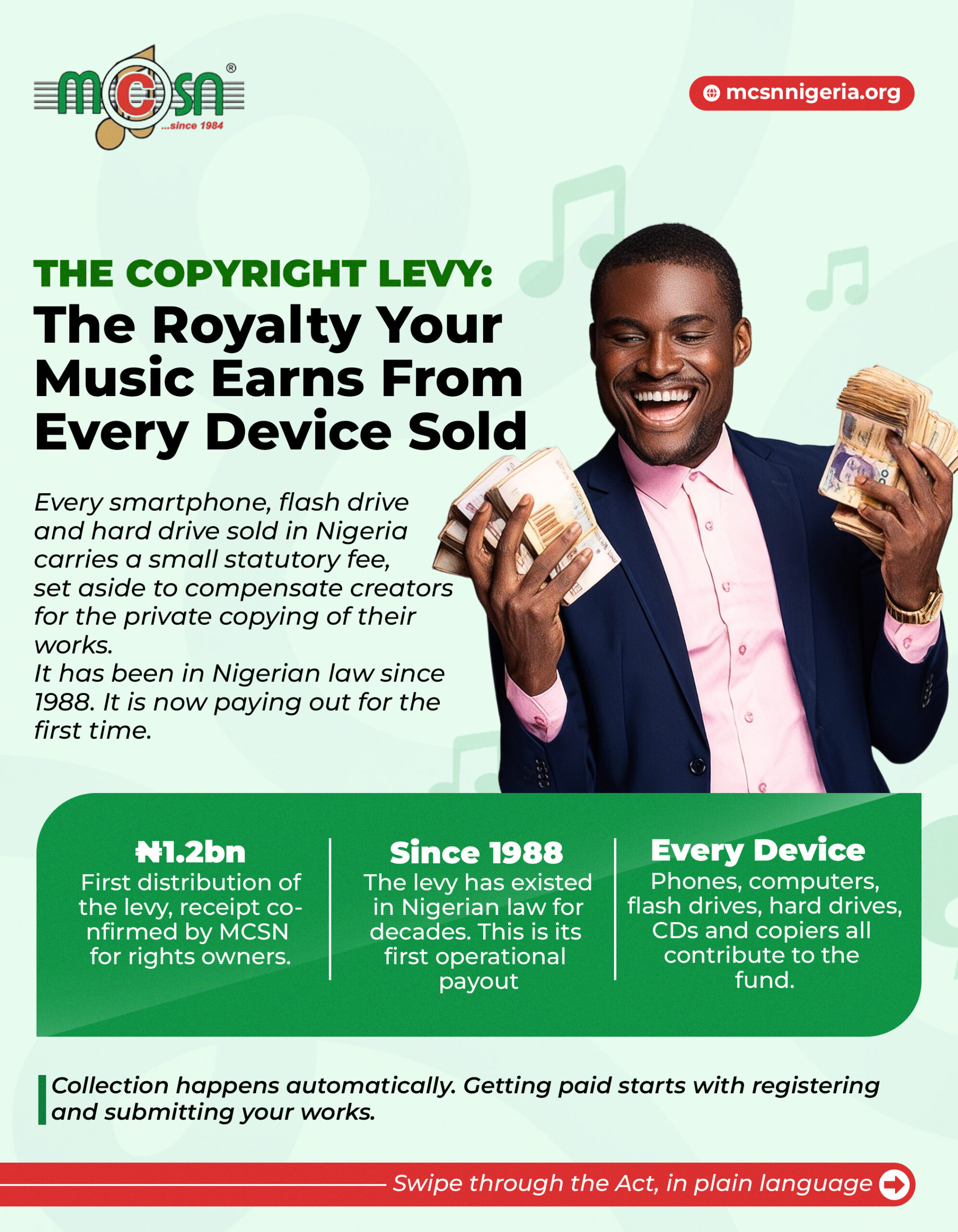
Levy on copyright material
Section 89 establishes a levy on materials used or capable of being used to infringe copyright.
The Act provides that the levy is prescribed by the Minister, while the funds are paid into the Fund of the NCC, subject to approved deductions. The Commission disburses the funds to approved CMOs in accordance with applicable regulations. This provision existed on paper since 1988 and sat unimplemented for decades before its first tranche was disbursed to MCSN in 2026.
NCC’s Dispute Resolution Panel
The Commission may constitute a three-member panel to resolve disputes over royalty payments, licence terms, or other matters requiring Commission determination. Anyone dissatisfied with the panel’s decision can apply to court for review. For a creator weighing years of Federal High Court litigation, this is a genuinely useful faster alternative, alongside the right to sue.
The Nigerian Copyright Act Is Finally on Your Side
The Nigerian Copyright Act 2022 is the most important legal development the Nigerian music industry has seen in a generation. It treats creativity as the serious economic activity it has always been. It protects your music from the moment of creation. It entitles you to royalties when your work is broadcast. It gives you moral rights that cannot be bought. It acknowledges the digital world you actually operate in.
The creative economy in Nigeria is worth billions of naira. The Nigerian Copyright Act for musicians finally gives artists the legal foundation to claim their fair share of it.