If you create music, there is a system working behind the scenes to make sure you can earn from where and how that music is used. At the centre of that system is the Collective Management Organisation, or CMO.
But what exactly does a CMO do? How does it work? How is it different from a PRO? And what does it mean for you as a music creator in Nigeria?
This guide breaks it down simply. We’ll look at what CMOs do, how they work with rights holders and music users, how royalties move between organisations across countries, and how the system works in Nigeria, including the role of MCSN.
What Is a Collective Management Organisation (CMO)?
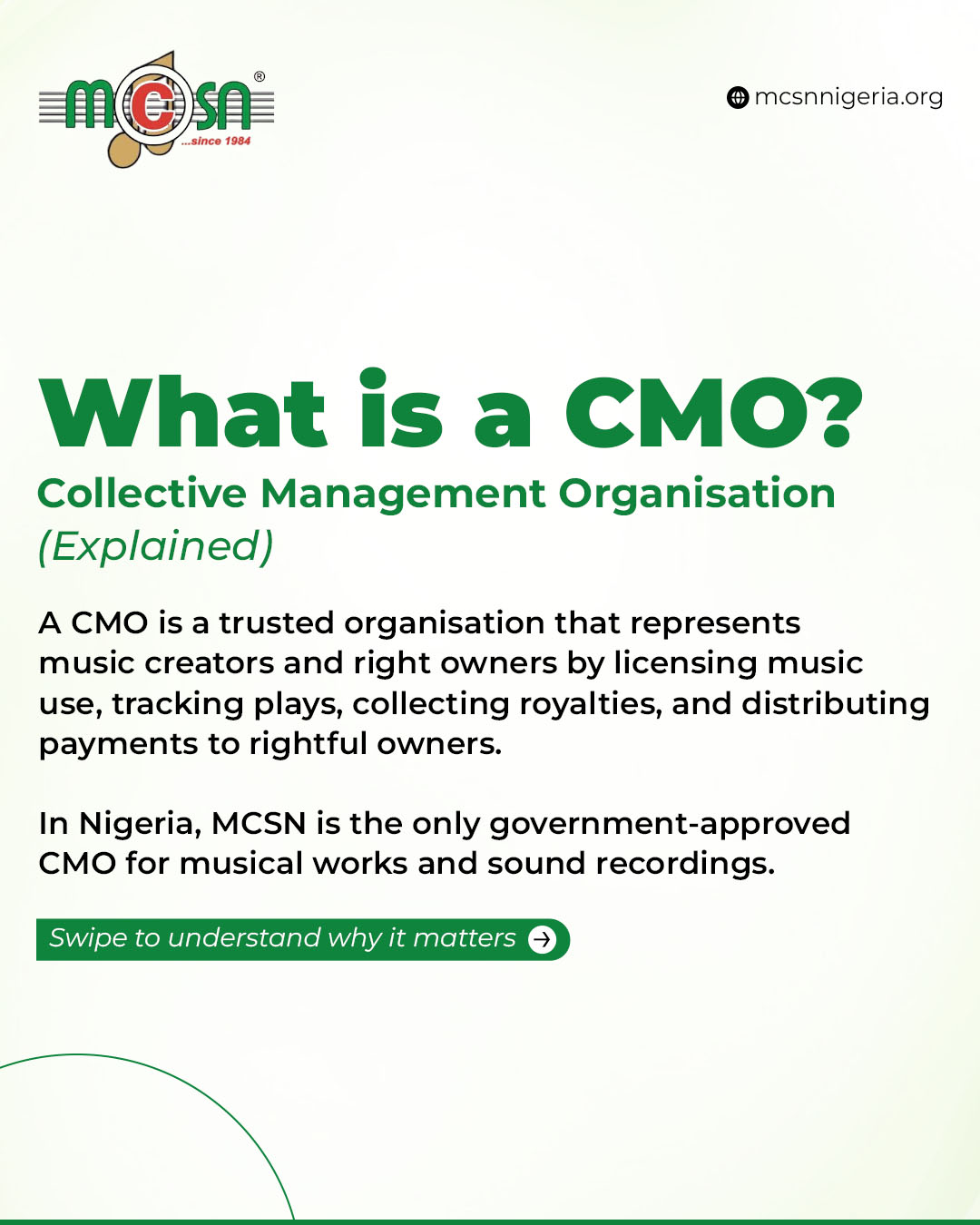
A Collective Management Organisation (CMO) represents music creators and rights owners collectively. It licenses businesses and platforms to use music legally, monitors where that music is used, collects the fees, and distributes the money as royalties to its members.
You may also come across terms such as collecting society, authors’ society, royalty collection society, or rights management organisation. In many contexts, they describe organisations performing a similar role.
Imagine trying to collect every royalty yourself. You would need to know every radio station that played your music, every business that used it, and every event where it was performed. You would have to track those uses, issue invoices, follow up on payments and deal with users who refused to pay.
Now imagine thousands of creators doing the same thing, while businesses have to identify and pay thousands of individual rights holders. That is where a CMO comes in.
It sits between music creators and music users, making the process manageable: creators have one organisation to represent their rights, while businesses have one place to obtain licences and pay for the music they use.
The CMO then tracks, collects and distributes the money to the rights holders entitled to it.
What does a CMO actually do?
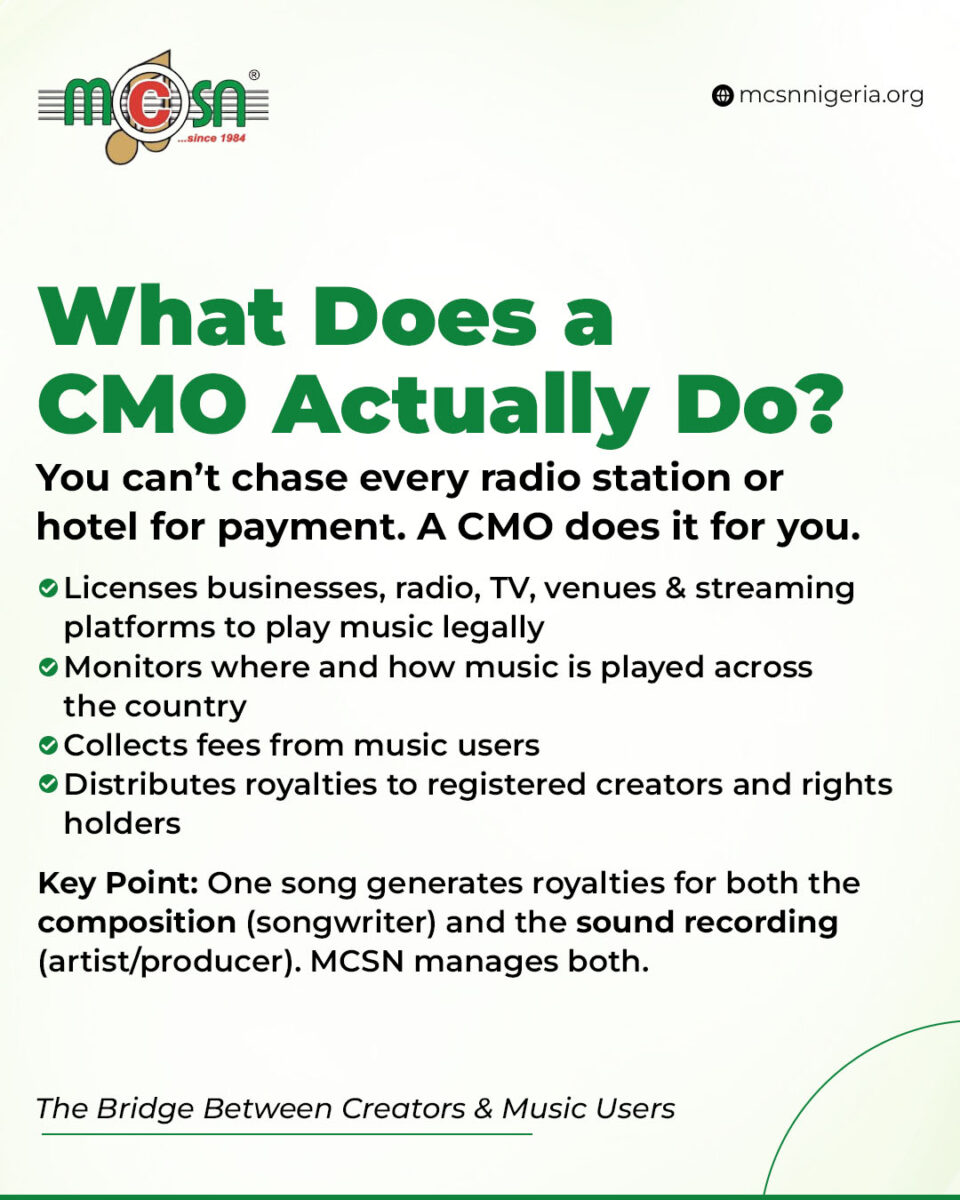
A CMO’s job can be understood as a simple four-step process: licence, monitor, collect and distribute.
First, it licenses music users such as broadcasters, venues, businesses and digital platforms to legally use the music in its repertoire. Instead of negotiating permission for every song separately, users can often obtain a single blanket licence covering the repertoire the CMO represents.
It then monitors where and how that music is used. This can involve broadcaster logs, cue sheets, digital usage reports and independent monitoring services to track what was played, where and how often. Next, it collects the licence fees owed by those music users.
Finally, it distributes the money. The CMO matches usage data with registered works, calculates what each rights holder is entitled to, and pays the royalties accordingly.
Each step depends on the one before it. But the entire process starts with one thing: registration. If a work is not properly registered and cannot be identified, the CMO may not know who should receive the royalty.
CMO vs PRO: What Is the Difference?
These two terms get used interchangeably, and the confusion costs creators money. The relationship is simpler than it looks.
CMO is the umbrella term. A PRO is one type of CMO. Every PRO is a CMO. Not every CMO is only a PRO.
What a PRO covers
A Performing Rights Organisation administers performing rights in musical works. That means the royalty generated when a composition is played publicly: on radio, on television, in a venue, at an event, or streamed. ASCAP in the United States and SAMRO in South Africa are examples of bodies whose primary mandate is performing rights.
What a full CMO covers
A full-scope CMO administers performing rights and more besides:
- Performing rights in the composition, when a song is played or broadcast publicly.
- Mechanical rights in the composition, when it is reproduced, which now includes every stream and download.
- Neighbouring rights in the sound recording, which belong to the performers, producer and label rather than the writer.
MCSN is a full CMO. We administer musical works and sound recordings, which is the reason a Nigerian creator who both wrote and recorded a track can collect on every side of it from a single membership.
Why the difference matters to you
In markets where composition and recording rights sit with separate organisations, a creator has to join more than one body to collect everything they are owed. Miss one, and that income stream simply never arrives. Because MCSN covers both categories, that particular trap does not exist in Nigeria, provided you register in every role you actually perform.
The Categories of Rights a CMO Manages
To follow how any of this works, you need the distinction that underpins the entire industry. Every piece of recorded music contains two separate legal assets, owned by different people and generating different royalties.
Musical works, also called composition or publishing rights
- What it is: the melody, the lyrics, the harmony and the structure. The song itself, before anybody records it.
- Who owns it: composers, songwriters, authors, lyricists and their publishers.
- What triggers payment: the composition being performed, broadcast, streamed or reproduced.
- Royalties earned: performing rights and mechanical rights.
- In practice: a songwriter earns whenever their song is played on radio, placed in a film, or streamed, including on recordings by other artists.
Sound recordings, also called master or neighbouring rights
- What it is: the specific recorded version that came out of the studio. Three artists recording the same song create three separate sound recordings.
- Who owns it: recording artists, session performers, music producers and record labels.
- What triggers payment: that particular recording being broadcast, played publicly or streamed.
- Royalties earned: neighbouring rights, also called related rights.
- In practice: a producer and a session guitarist both earn when the recording plays on radio, whether or not either wrote a note of the song.
One radio play, two royalties
Your track plays once on XYZ FM. That single broadcast uses both assets at the same time, so it generates two separate royalties. The songwriter and publisher earn a performing right royalty on the composition. The recording artist, producer and label earn a neighbouring right royalty on the master. Two payments, two sets of recipients, one play.
MCSN administers both. If you wrote the song and recorded it yourself, both belong to you, but only if you registered in both capacities. Registering as a performer alone leaves the composition income unclaimed, and the reverse is equally true.
CMOs Around the World
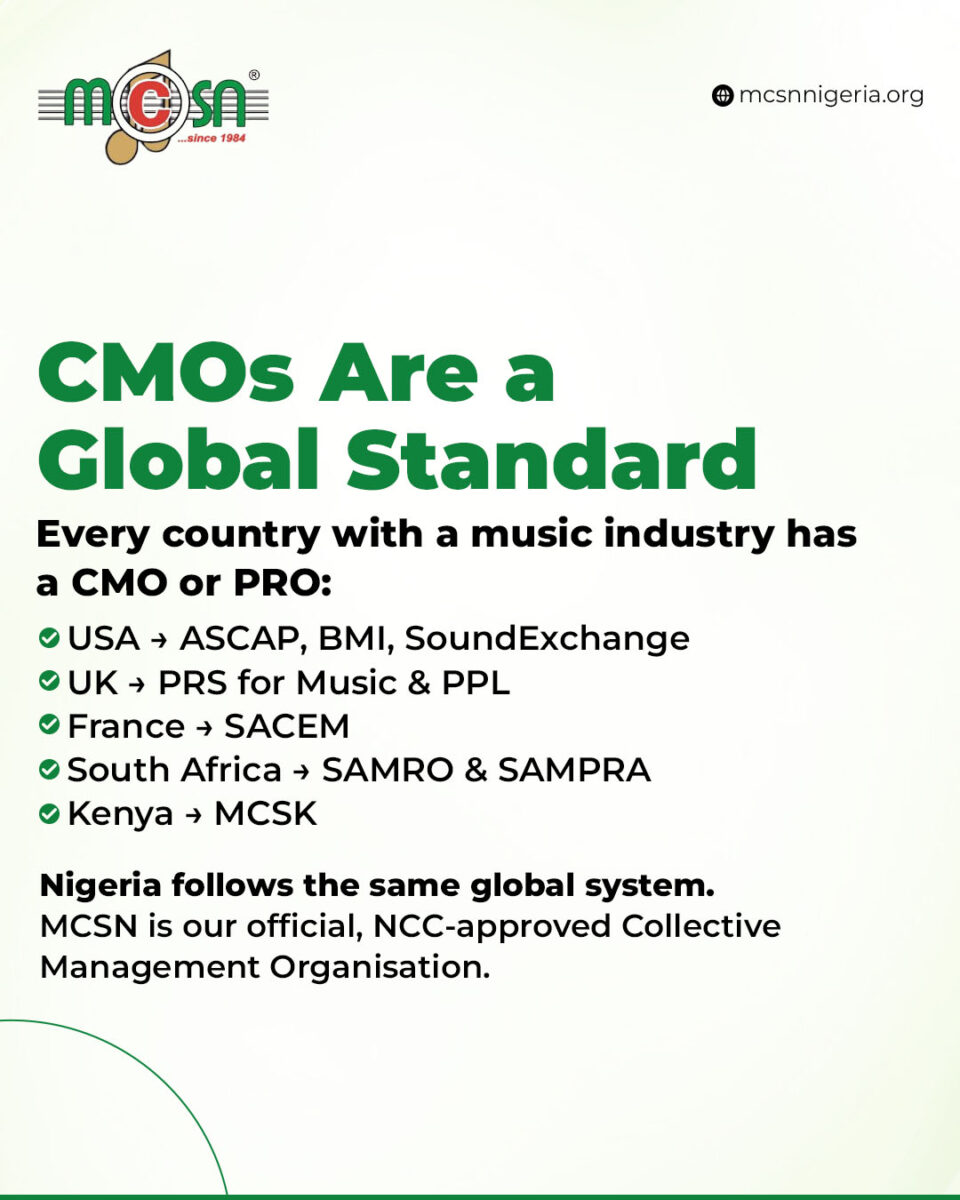
CMOs are not a Nigerian invention or a Nigerian peculiarity. Every country with a functioning music industry has at least one, usually established or recognised under that country’s copyright legislation. Here is how the role is filled across the major markets:
Africa
- MCSN (Nigeria). Full CMO covering musical works and sound recordings. The only body approved by the Nigerian Copyright Commission to licence and collect for both categories.
- SAMRO (South Africa). Performing rights in musical works, operating across Southern Africa.
- CAPASSO (South Africa). Mechanical rights in musical works.
- SAMPRA (South Africa). Neighbouring rights in sound recordings, on behalf of performers and record companies.
- GHAMRO (Ghana). The Ghana Music Rights Organisation, the country’s approved collecting society.
- MCSK (Kenya). Musical works, on behalf of authors, composers and publishers. Kenya handles performers and producers through two separate bodies, KAMP and PRISK.
- SODAV (Senegal), COSOTA (Tanzania), ZIMURA (Zimbabwe). National societies running the same model across the continent.
North America
- ASCAP, BMI and SESAC (United States). Performing rights in musical works.
- The MLC (United States). Mechanical rights for digital reproduction, established under the Music Modernization Act.
- SoundExchange (United States). Neighbouring rights. Digital performance royalties for sound recordings.
- SOCAN (Canada). Performing and reproduction rights in musical works.
- Re:Sound (Canada). Neighbouring rights in sound recordings, for performers and record companies.
Europe
- SACEM (France). Performing and mechanical rights in musical works. One of the largest societies in Europe.
- GEMA (Germany). Musical works, performing and mechanical. State-supervised, and effectively the sole society of its kind in Germany.
- STIM (Sweden), SIAE (Italy), SGAE (Spain), Buma/Stemra (Netherlands). The same structure repeated across the rest of the continent.
Asia and the Pacific
- JASRAC (Japan). Musical works. One of the largest societies in Asia.
- IPRS (India). Musical works, performing and mechanical. Sound recordings are administered separately by PPL India.
- APRA AMCOS (Australia and New Zealand). APRA covers performing rights, AMCOS covers mechanical, run as a single organisation.
- MACP (Malaysia) and COMPASS (Singapore). National societies for musical works.
Latin America
- ECAD (Brazil). Collects performing rights royalties centrally and distributes them through Brazil’s associated societies.
- SADAIC (Argentina) and SACM (Mexico). National societies for musical works.
How CMOs Move Royalties Across Borders
CISAC, the International Confederation of Societies of Authors and Composers, is the global federation that links these organisations together. Founded in Paris in 1926, it now connects more than 225 member societies across more than 110 countries, representing over five million creators.
Societies also sign reciprocal representation agreements directly with one another. Under those agreements, each society collects in its own territory on behalf of the other’s members and remits what it collects.
Why MCSN Is Nigeria’s CMO
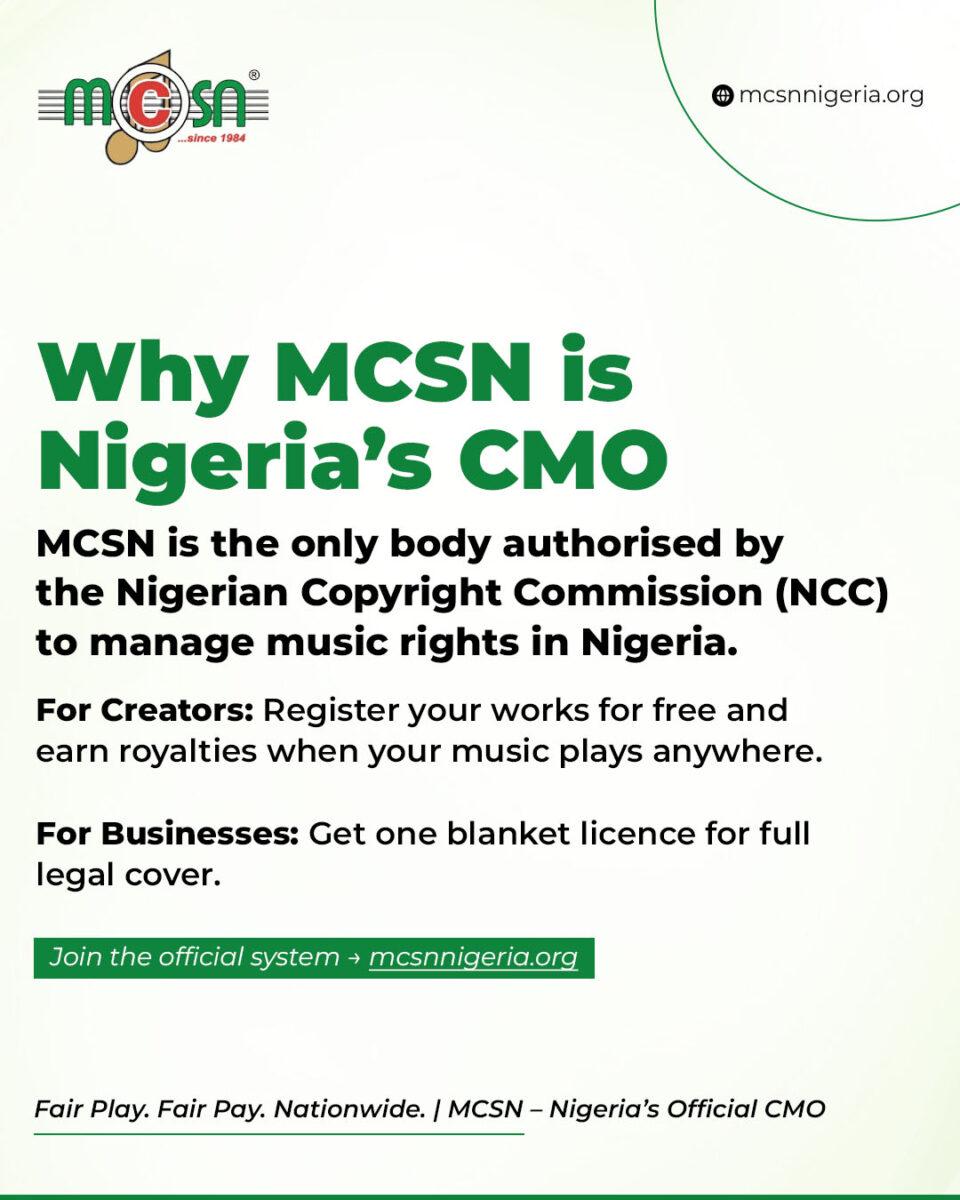
Every market has a body performing this role; Nigeria’s is the Musical Copyright Society Nigeria, founded in 1984. MCSN holds approval from the Nigerian Copyright Commission, the government agency responsible for copyright regulation under the Federal Ministry of Justice. That approval is what gives an organisation legal authority to licence on behalf of rights holders nationwide, to enforce those licences, and to collect and distribute.
Under the Copyright Act 2022, operating a collecting society without that approval is not permitted. It is the difference between a licence that holds up and one that does not.
What MCSN covers
MCSN’s mandate spans both categories of rights:
- Musical works. Composition and publishing rights, for songwriters, composers, lyricists and publishers.
- Sound recordings. Neighbouring rights, for recording artists, session performers, producers and record labels.
Across those two categories it collects four royalty types: performing, mechanical, neighbouring and sync.