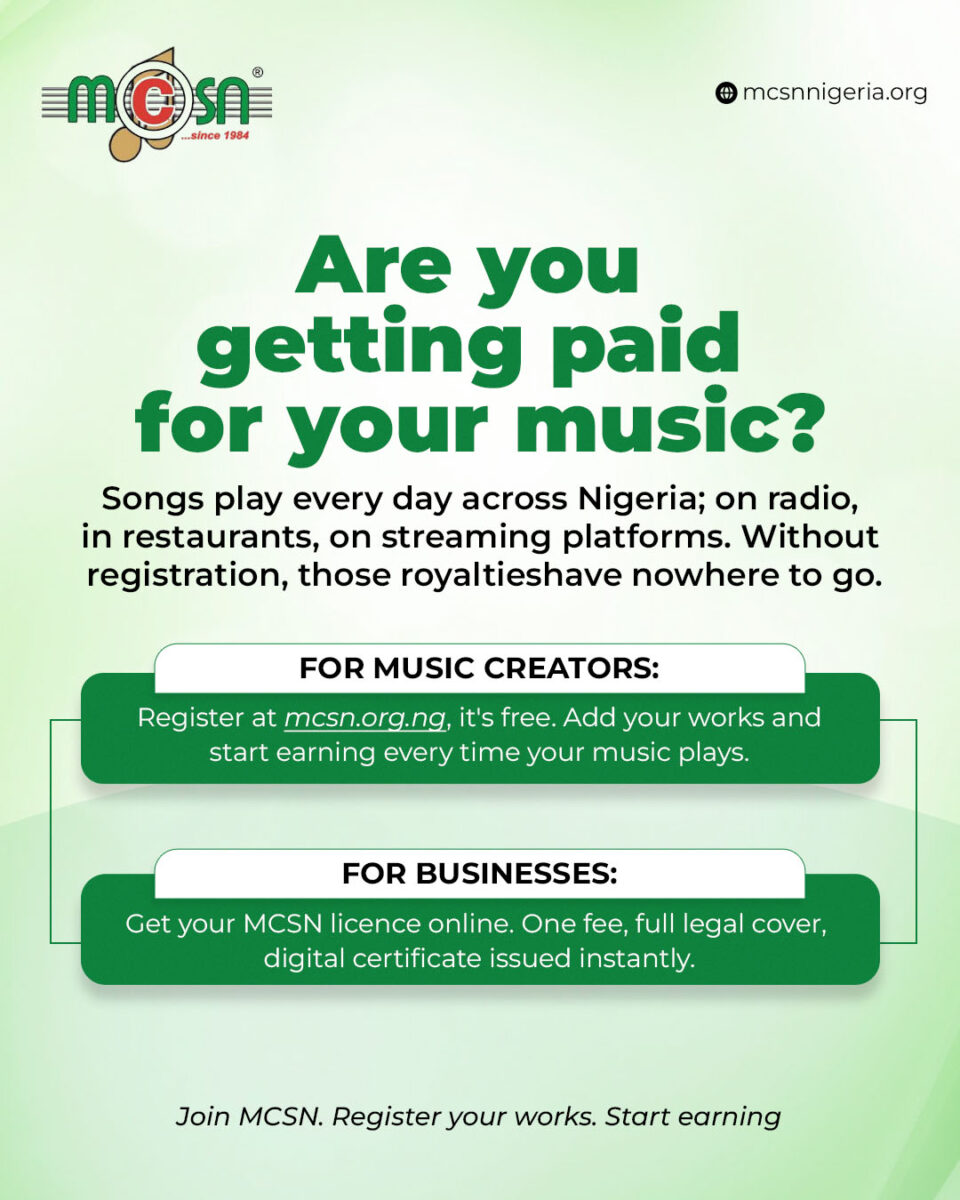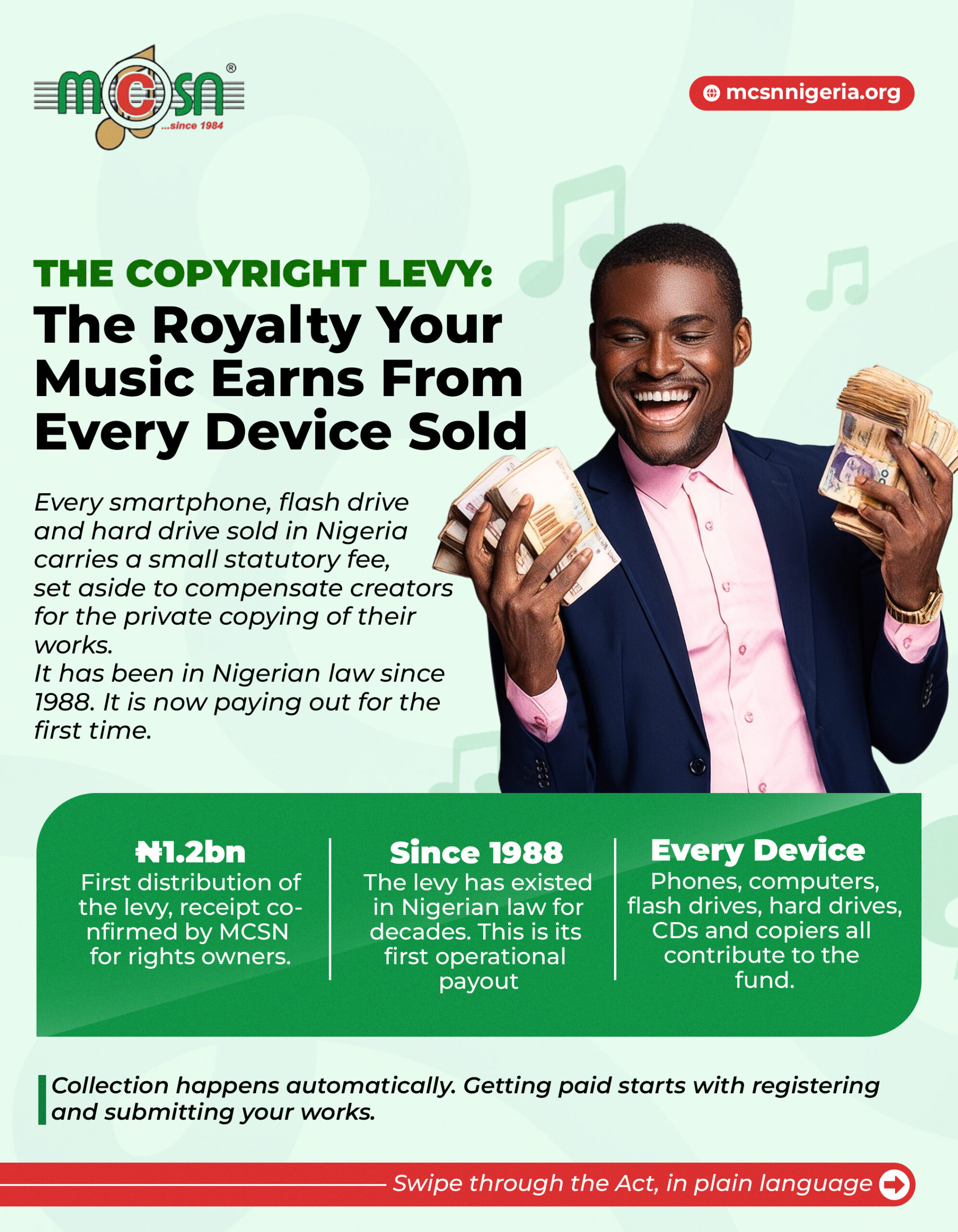
If you make music in Nigeria, or you use music in your business, MCSN is the organisation you need to know. Here is everything explained, plainly.
Right now, somewhere in Nigeria, your song is playing. On a radio station in Lagos. In a restaurant in Abuja. On someone’s phone in Port Harcourt. The question is whether any of that is turning into money in your account.
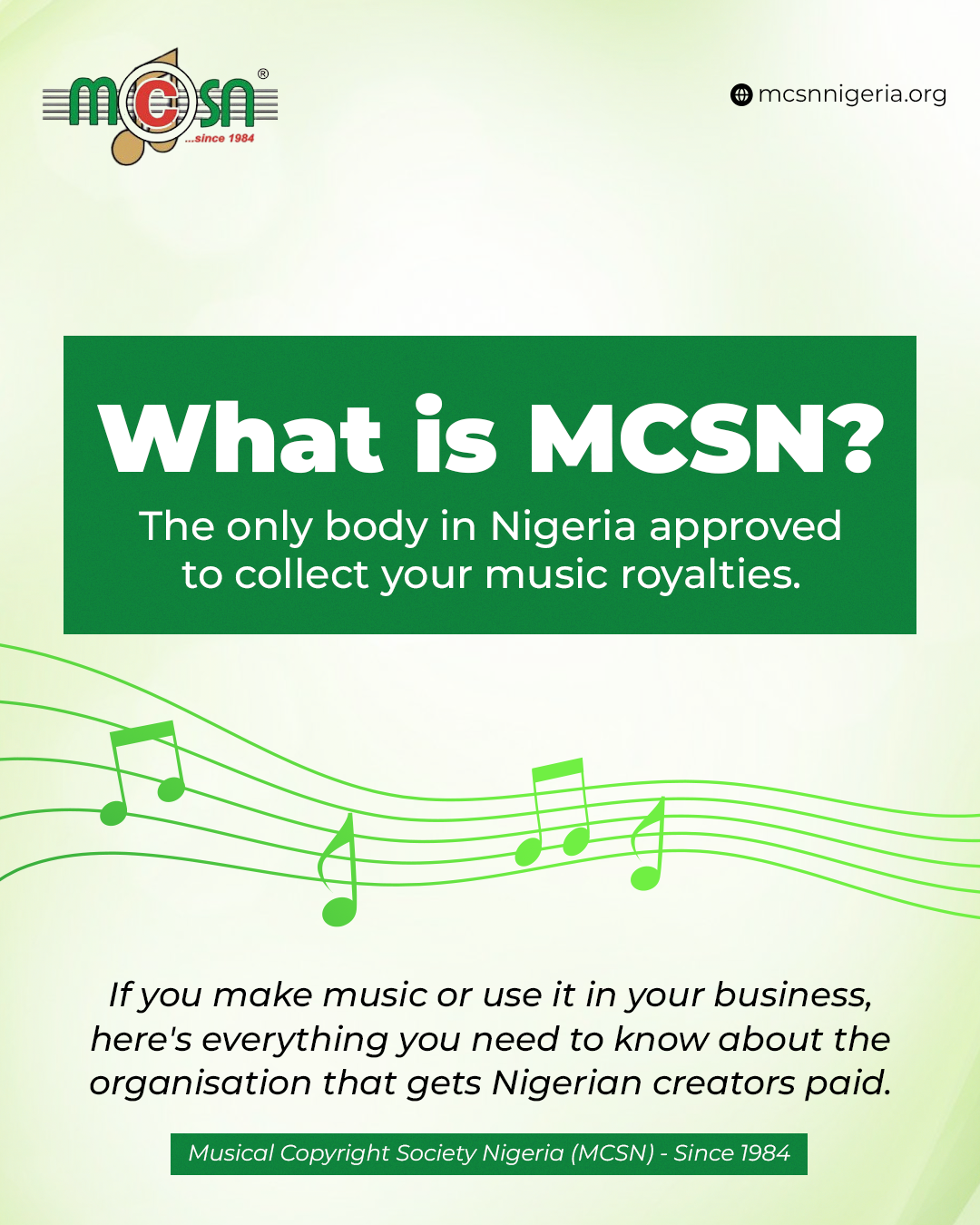
MCSN, the Musical Copyright Society Nigeria, is the answer to that question. It is the only organisation approved by the Nigerian Copyright Commission to licence music use, monitor where music is played, and collect and distribute royalties for musical works and sound recordings across Nigeria. Founded in 1984, it is free for creators to join and legally required for businesses that play music in public.
This guide covers what MCSN is, what we do, which royalties we collect, who qualifies for membership, and what the law requires of businesses that use music.
What Is MCSN?
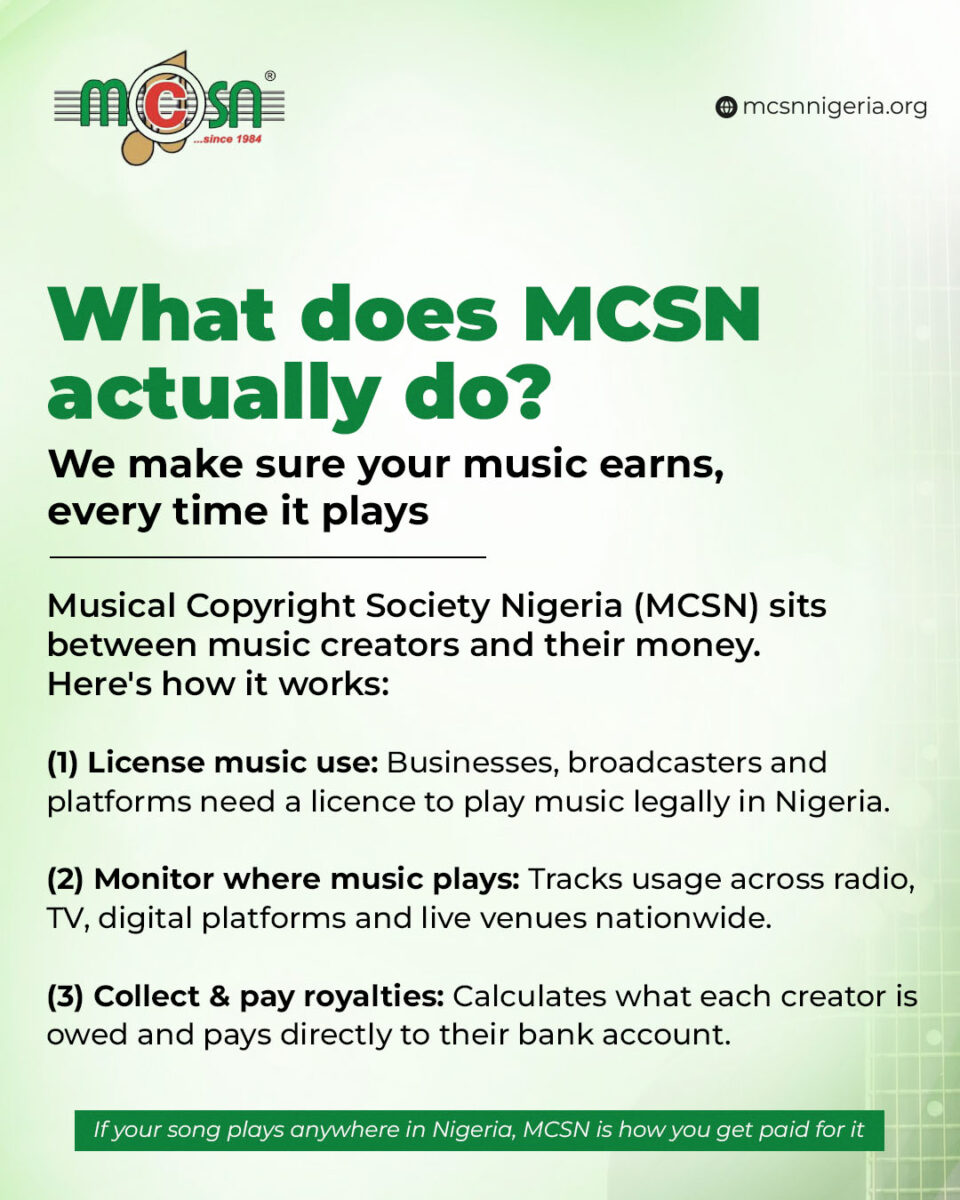
MCSN stands for the Musical Copyright Society Nigeria, founded in 1984. We are a Collective Management Organisation (CMO) representing many rights holders at once so that music can be licensed, tracked and paid for at national scale, rather than song by song. MCSN does three things on behalf of Nigerian music creators and rights owners:
- Licence: We grant businesses, broadcasters, venues and digital platforms the legal right to use music.
- Monitor: We track where and how music is played across Nigeria.
- Distribute: We collect the fees generated by that use and pay them out as royalties to registered members.
The simplest way to picture MCSN is as the infrastructure between a musician and their money. When a radio station plays your song, it has a legal obligation to pay for that use. MCSN is the body that collects the payment and makes sure it reaches the people who own the song.
Why MCSN Is Nigeria’s Only Approved CMO for Music
MCSN holds a formal approval from the Nigerian Copyright Commission (NCC) to licence, monitor and distribute royalties for both musical works and sound recordings.
What NCC approval actually means for MCSN
The Nigerian Copyright Commission (NCC) is the country’s official government body for copyright regulation. It sits under the Federal Ministry of Justice and is responsible for administering the Nigerian Copyright Act.
When the NCC approves a CMO, it grants that organisation legal authority to act on behalf of rights holders nationwide: to issue licences that are valid in law, to enforce them, and to collect and distribute on members’ behalf. No other body in Nigeria holds this approval for music, which makes MCSN the only legitimate route for collecting and distributing music royalties in the country.
MCSN and the Nigerian Copyright Act 2022
Nigeria’s copyright framework is set out in the Copyright Act 2022 (Act No. 8 of 2022), which replaced the previous legislation. The Act confirms that copyright exists in a work from the moment it is created and fixed in a definite medium. You own your song without registering it anywhere.
Owning a right and collecting money from that right are two different things. Copyright gives you ownership. MCSN membership gives you the mechanism to be paid, because a royalty can only be paid on a work the system can identify.
What Does MCSN Actually Do?
MCSN’s work breaks into three practical functions. Which one matters most to you depends on whether you make music or use it.
1. Licensing music use in Nigeria
Any business or individual using music commercially in Nigeria needs a licence from MCSN. That covers a wide range of music users:
- Radio and television stations
- Hotels, restaurants, bars and lounges
- Gyms and fitness centres
- Shopping malls and retail stores
- Event organisers and promoters
- Streaming platforms and digital services
- Clubs and nightlife venues
- Places of worship
- Corporate offices and workspaces
Instead of tracing and negotiating with thousands of individual songwriters, artists, producers and labels, a business obtains a licence from MCSN and is covered for the entire catalogue MCSN represents. Without a licence, every song played on the premises is an unauthorised public performance. With one, the business is compliant, and the fee it pays flows back to the creators whose work is being used. One agreement, one annual fee, full legal cover.
2. Monitoring music usage across Nigeria
Collecting licence fees is only half the job. MCSN also has to establish where and how music is being played so it knows who to pay and how much. Monitoring happens through several channels:
- Broadcasters and streaming platforms submit usage logs, which are records of exactly what was played and when
- MCSN works with independent monitoring services
- Digital platforms supply play data directly
This is why registering your works matters so much. A song that is not in the system cannot be matched to a usage record. The royalties that song generated still exist. They simply have no owner to be sent to.
3. Distributing MCSN royalties to creators
After collecting fees and matching them to usage, MCSN calculates what each rights holder is owed and pays out.
MCSN operates a log-based distribution model, which means payments are tied directly to verified usage data rather than estimates. The more a registered work is played on licensed platforms, the more its owners earn. Distributions run on a regular schedule and are paid straight into the bank account each member provides at registration. Members also receive statements showing which platforms used their music, how often, and at what rate.
The Two Rights MCSN Administers
To understand what MCSN pays you for, you need to know that every song contains two separate legal assets. They have different owners and they generate different royalties.
Musical works, also called the composition
The musical work is the melody, the lyrics and the underlying structure of the song. It exists before anyone records it, and it stays the same even when another artist covers it. Songwriters, composers, lyricists and publishers own this asset.
Sound recordings, also called the master
The sound recording is the specific recorded version that came out of the studio. If three artists record the same song, there are three separate sound recordings. Recording artists, session performers, producers and record labels hold rights here.
When your song plays on a Lagos radio station, both assets are used at once, so two separate royalty streams are generated by a single broadcast. MCSN administers both sides, which is what allows a creator who wrote and recorded their own material to collect fully from one membership.
Which Royalties Does MCSN Collect?
MCSN collects across four royalty types:
- Performing rights: Earned when a composition is performed or broadcast publicly on radio, television, streaming services, in venues and at events. Paid to songwriters, composers and publishers.
- Mechanical rights: Earned when a composition is reproduced, which includes every stream and every download. Also paid to songwriters, composers and publishers.
- Neighbouring rights: Earned when a sound recording is broadcast or played publicly. Paid to recording artists, performers, producers and labels.
- Sync rights: Earned when music is paired with moving images in film, television, advertising or online video. The composition and the recording earn separately.
A single play can trigger more than one of these at the same time. That is why creators registered in only one role often collect far less than they are actually owed.
Who Can Become an MCSN Member?
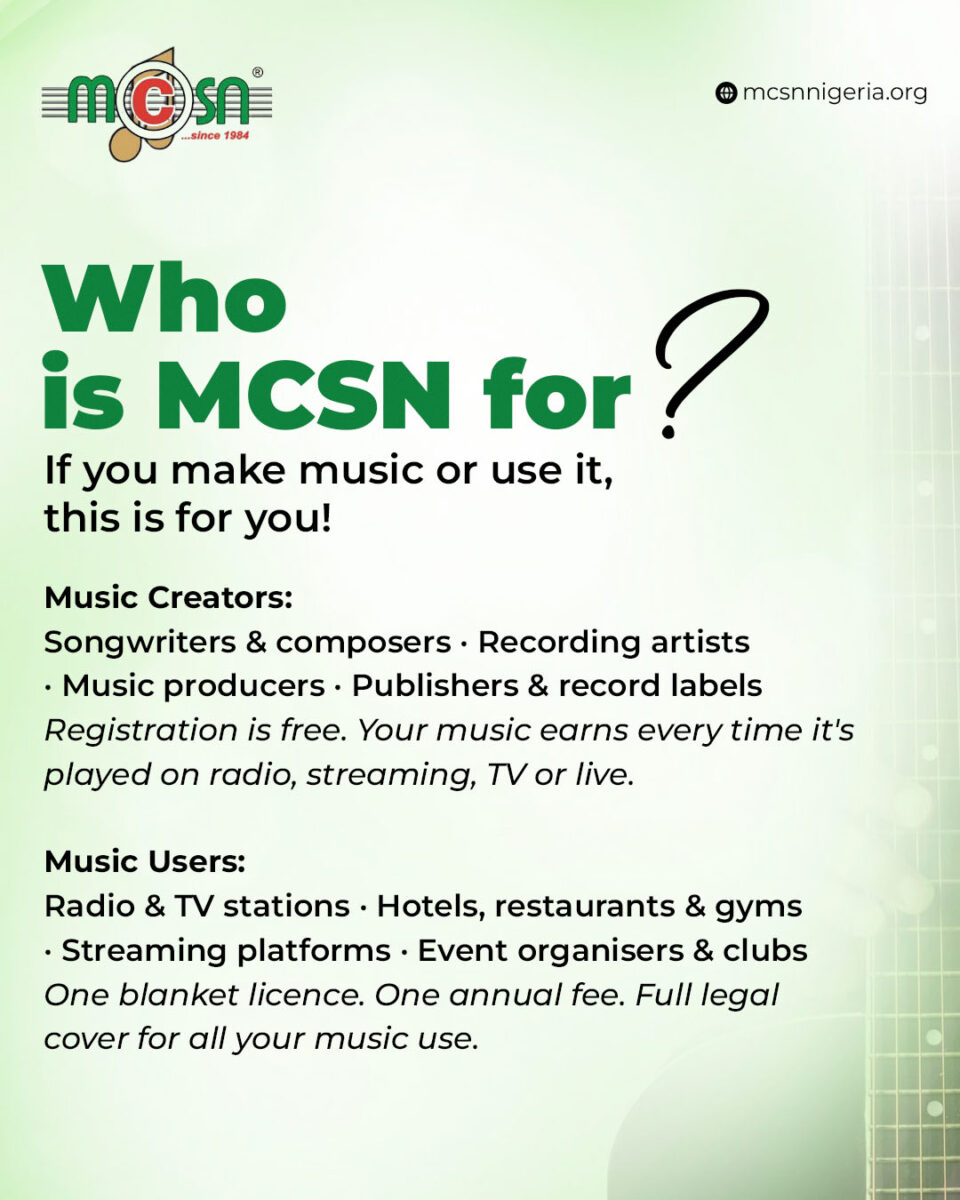
MCSN membership is open to any Nigerian music creator or rights owner with an interest in a musical work or a sound recording. You do not need to be signed, famous or professionally represented. If you have written, composed, produced or performed music and you own or co-own the rights to it, you qualify. These are the roles MCSN represents, and what each one covers.
Composers
A composer creates the music itself: the melody, the harmony, the chord structure and the arrangement. If you built the musical part of a song, whether at a keyboard, on a DAW or in a rehearsal room, you are a composer and you hold a share of the musical work.
Songwriters
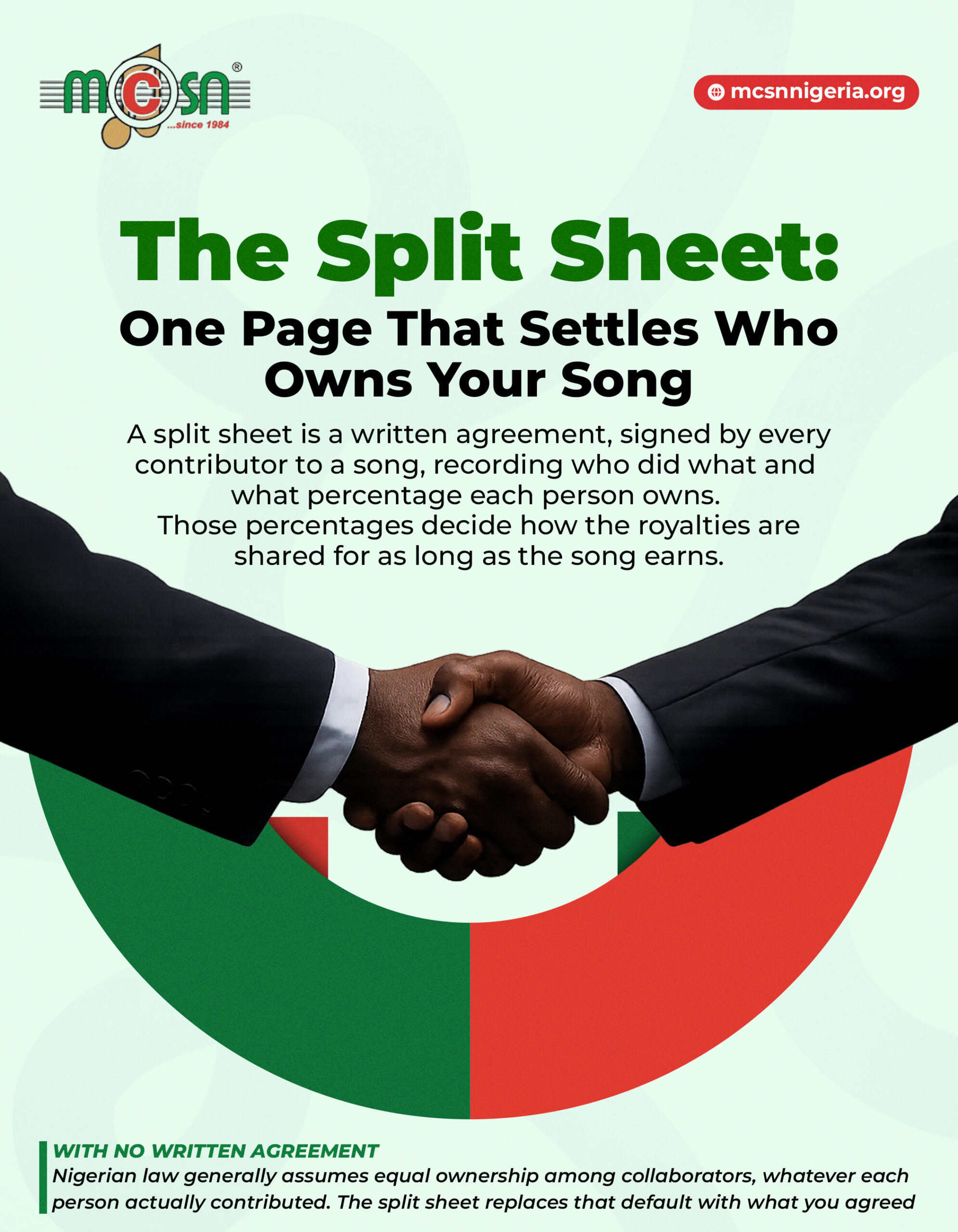
A songwriter creates the song as a whole, usually words and music together. Most Nigerian songs have more than one writer, and each writer holds a percentage of the composition. Those percentages are what a split sheet records, and they are what MCSN pays against.
Authors and lyricists
An author or lyricist writes the words. Lyrics are protected in their own right, so a contributor who wrote only words still owns a share of the musical work and earns performing, mechanical and sync royalties from it.
Performers and recording artists
A performer is anyone whose performance is captured on the recording: the lead vocalist, backing vocalists, instrumentalists and session musicians. Performers hold neighbouring rights in the sound recording, earned separately from any songwriting credit. A session guitarist who wrote nothing at all still holds a right in that master.
Music producers
A producer shapes the recording: the beat, the production, the direction of the session and the finished sound. Producers hold rights in the sound recording, and where they contributed to the melody or structure they may also hold a share of the composition. What a producer owns depends on what was agreed and documented in writing.
Publishers and record labels
A publisher administers compositions on behalf of writers, registering works, licensing them and collecting the income they generate. A record label typically owns the sound recording outright under contract with the artist. Both register with MCSN as rights owners so the works in their catalogues are monitored and paid.
How to register with MCSN
Registration is free to apply for. Once your application is approved you receive a unique MCSN Member ID that links your identity to your registered works in the national royalty system. From that point, every work you submit is monitored, matched against usage data and eligible for distribution.
- Apply online at mcsnnigeria.org with your details and identification.
- Receive approval and your unique MCSN Member ID.
- Submit your works, listing every contributor, their role and the agreed splits.
- Add your bank account so royalties can be paid directly to you.
- Keep your catalogue current as you release new material.
Accurate ownership data is the single biggest factor in being paid correctly. If splits are wrong or a contributor is missing, distribution is delayed or misdirected. Agree your splits in writing before a song is released.
What MCSN Means for Businesses in Nigeria: How to get an MCSN licence
The Nigerian Copyright Act requires any business that plays music publicly to be licensed. A hotel playing music in its lobby, a radio station broadcasting daily, a gym running playlists through the day, a restaurant, an event promoter, a retail store, a salon, a streaming service: all of them need a valid MCSN licence.
One point that catches businesses out: a personal streaming subscription does not cover commercial use. Consumer services license private listening only. Playing that account through speakers in a venue is still an unlicensed public performance.
Using music commercially without a licence puts a business in breach of the Nigerian Copyright Act and exposes it to enforcement action and to civil claims from rights holders. The cost of compliance is considerably lower than the cost of a dispute.
Applications are made online. Once the annual fee is paid, MCSN issues a digital certificate carrying a QR code that anyone can scan to verify compliance instantly. A licensed business is not only protected legally, it is also contributing to a system that pays Nigerian creators fairly for their work.