If you make music in Nigeria, two names come up whenever copyright, licensing or royalties are discussed: the Nigerian Copyright Commission (NCC) and the Musical Copyright Society Nigeria (MCSN).
Both matter to the industry as we do very different jobs. One is a government regulator, the other is a collective management organisation that represents rights holders and turns those rights into income.
That difference matters, because copyright is not only about stopping people from stealing your music. It is about making sure that when your music is used commercially, the people who own it can be identified, licensed and paid.
What Is the Nigerian Copyright Commission (NCC)?
Search “NCC Nigeria” and you will meet two agencies sharing one acronym:
- The Nigerian Communications Commission regulates telecoms. MTN, Airtel, Glo, data prices, SIM registration, spectrum.
- The Nigerian Copyright Commission regulates copyright. Songs, books, films, software, photographs, piracy and collective management.
The Nigerian Copyright Commission is the federal agency responsible for the administration, regulation and enforcement of copyright in Nigeria. It began as the Nigerian Copyright Council, created under the Copyright Decree of 1988 and inaugurated the following year, and was upgraded to a full commission with enforcement powers in 1996.
Its current legal foundation is the Copyright Act 2022, signed into law in March 2023, which repealed the 1988 Act. Section 78 is where the Commission’s powers live, and they are deliberately broad.
A few facts:
- It operates under the Federal Ministry of Justice.
- Its headquarters is in Abuja, with zonal and state offices across the country.
- It is headed by a Director-General, currently Dr John Asein, first appointed in 2019 and reappointed in January 2023.
- It runs the Nigerian Copyright Academy as its training arm.
Its remit is far wider than music. Copyright covers literary works, musical works, artistic works, films and sound recordings, and the Commission administers all of them. The NCC creates and supervises the framework. A CMO operates within it.
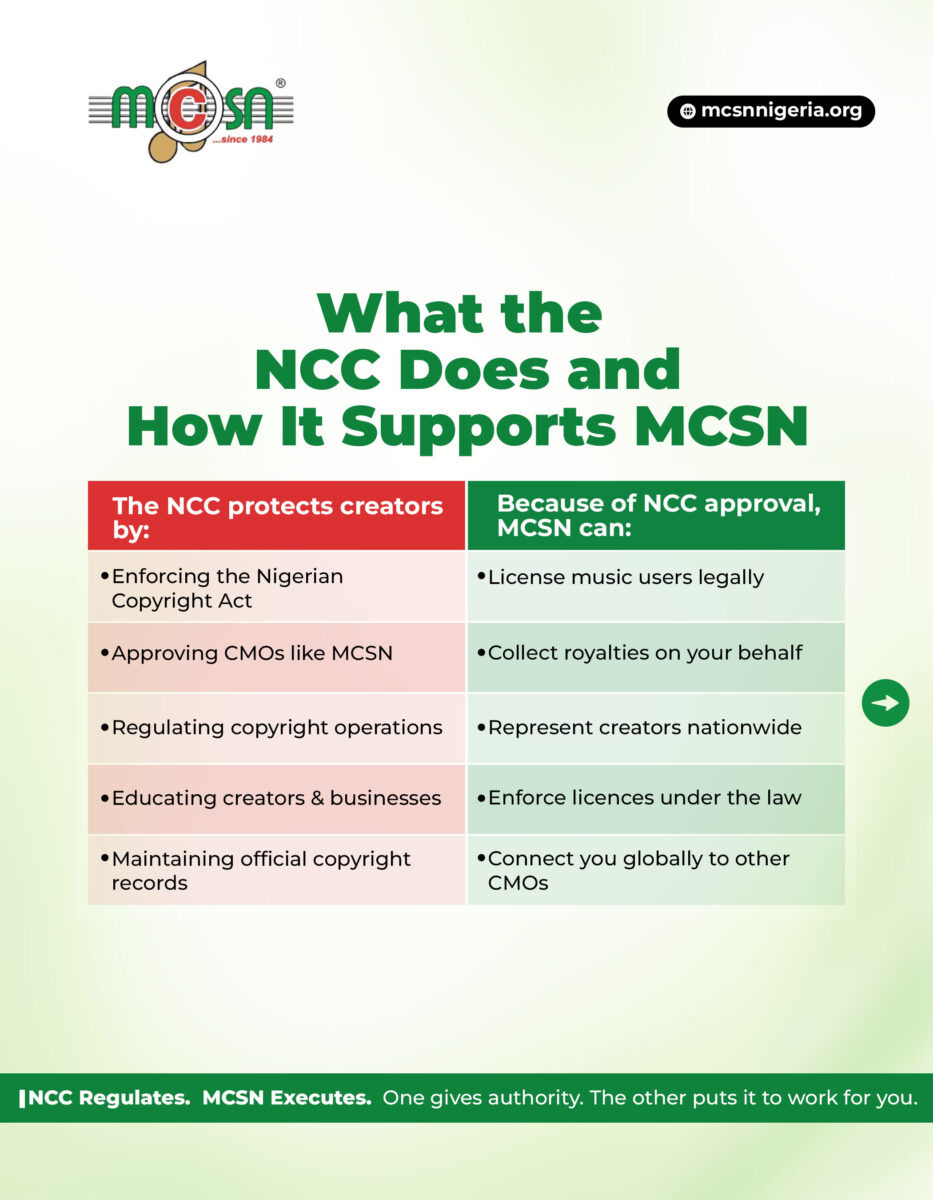
What the NCC Does, and How It Supports MCSN
Seven functions matter to creators and to the businesses that use music.
1. NCC administers and interprets copyright law
The Commission is responsible for all matters affecting copyright in Nigeria. It issues regulations, guidelines and public notices that put flesh on the bones of the Act. Where the Act says something should be done “as prescribed”, it is usually the Commission doing the prescribing.
A recent and significant example: in January 2025 it issued the Collective Management Regulations 2025 (S.I. No. 17 of 2025), made under sections 78, 88 and 97, which repealed and replaced the 2007 regulations that had governed collecting societies for nearly two decades. The new rules raise the bar on CMO governance, accountability, member rights and reporting.
In plain terms, approval is no longer a certificate you win once and frame. It is a standard an approved CMO has to keep meeting, year after year.
2. NCC maintains the national databank of works, through NCeRS
Copyright in Nigeria is automatic. The moment you fix an original work in a tangible form, copyright exists. You do not register to own it. There is no government stamp that creates your rights.
What the Commission does provide is the Nigerian Copyright eRegistration System (NCeRS), a voluntary notification scheme that places your work on an official record. You submit the work and the ownership details, pay the prescribed fee, and receive an acknowledgement certificate.
Why bother, if copyright is automatic? Because evidence wins disputes. The certificate gives you an independent, government-held record of what the work is, when you notified it, and who claimed authorship. In an argument over who wrote what in 2021, that is worth considerably more than a WhatsApp voice note. Certain statutory presumptions also apply only to registered works, which shifts the burden in your favour if a claim ever reaches court.
Works you can notify include musical works, sound recordings, literary works, artistic works and audiovisual works.
3. NCC approves and supervises collective management organisations
This is the function that connects the Commission directly to MCSN, and through MCSN to every music creator in the country.
Under section 88 of the Copyright Act 2022, no organisation may operate as a collective management organisation in Nigeria without the Commission’s approval. A statutory requirement, and operating without approval is a criminal offence carrying fines and possible imprisonment. An unapproved body cannot even sustain an infringement action as a CMO.
Before granting approval, the Commission examines the applicant’s corporate registration, its membership base and their signed consent, its governance structure, its capacity to administer rights, and its distribution rules. Approvals are time-limited and must be renewed, and renewals now have to satisfy the 2025 Regulations in full.
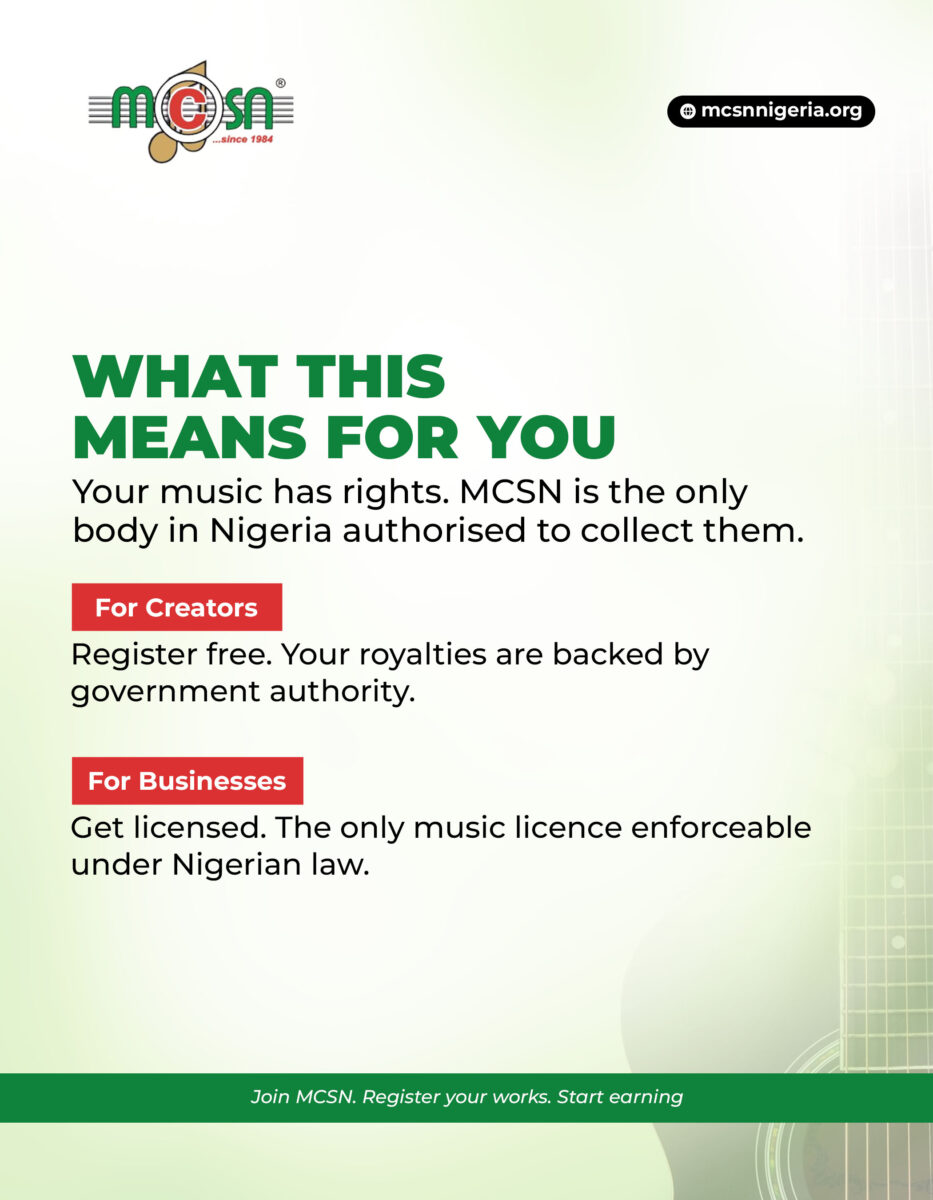
Why MCSN is the only one approved CMO for music
Section 88(3) bars the Commission from approving a second CMO for a category of works where an existing approved organisation already protects that category adequately. The Act is deliberately built for one approved body per class of rights, not a free-for-all.
The Commission has approved CMOs in other creative sectors, covering areas such as audiovisual and reprographic rights. For musical works and sound recordings, the approved body is MCSN. Our licence was most recently renewed by the Commission in a letter dated 16 January 2025, in accordance with the Copyright Act 2022.
When MCSN issues you a licence, we are not inventing an obligation. We are exercising an authority granted by the federal regulator under an Act of the National Assembly.
4. NCC enforces copyright and fights piracy
The Commission appoints copyright inspectors who hold the powers of police officers for copyright purposes. They conduct raids, seize infringing goods, seal premises where infringement is reasonably suspected, and initiate prosecutions.
The 2022 Act extended this into the digital space. Part VII deals specifically with online content and introduces a notice-and-takedown framework. The Commission may, directly or through a service provider, block or disable access to content, links or websites it reasonably believes to be infringing. Its S.T.O.P. unit has petitioned for the takedown of sites illegally streaming Nigerian music and film.
Criminal enforcement is the Commission’s territory, not a CMO’s. MCSN pursues unlicensed users through civil action. The Commission prosecutes crimes. Without an enforcer behind it, copyright would be a fine idea on paper that everybody ignores.
5. NCC resolves disputes
The 2022 Act gave the Commission something the old law did not: power to investigate and settle copyright disputes without a court case.
The Commission can constitute a dispute resolution panel with authority over disputes about royalty payments, licence terms, infringement and related matters. For a creator facing years of Federal High Court litigation, a petition to the Commission is now a genuine alternative.
This does not remove your right to sue. Copyright owners can still bring civil action in the Federal High Court.
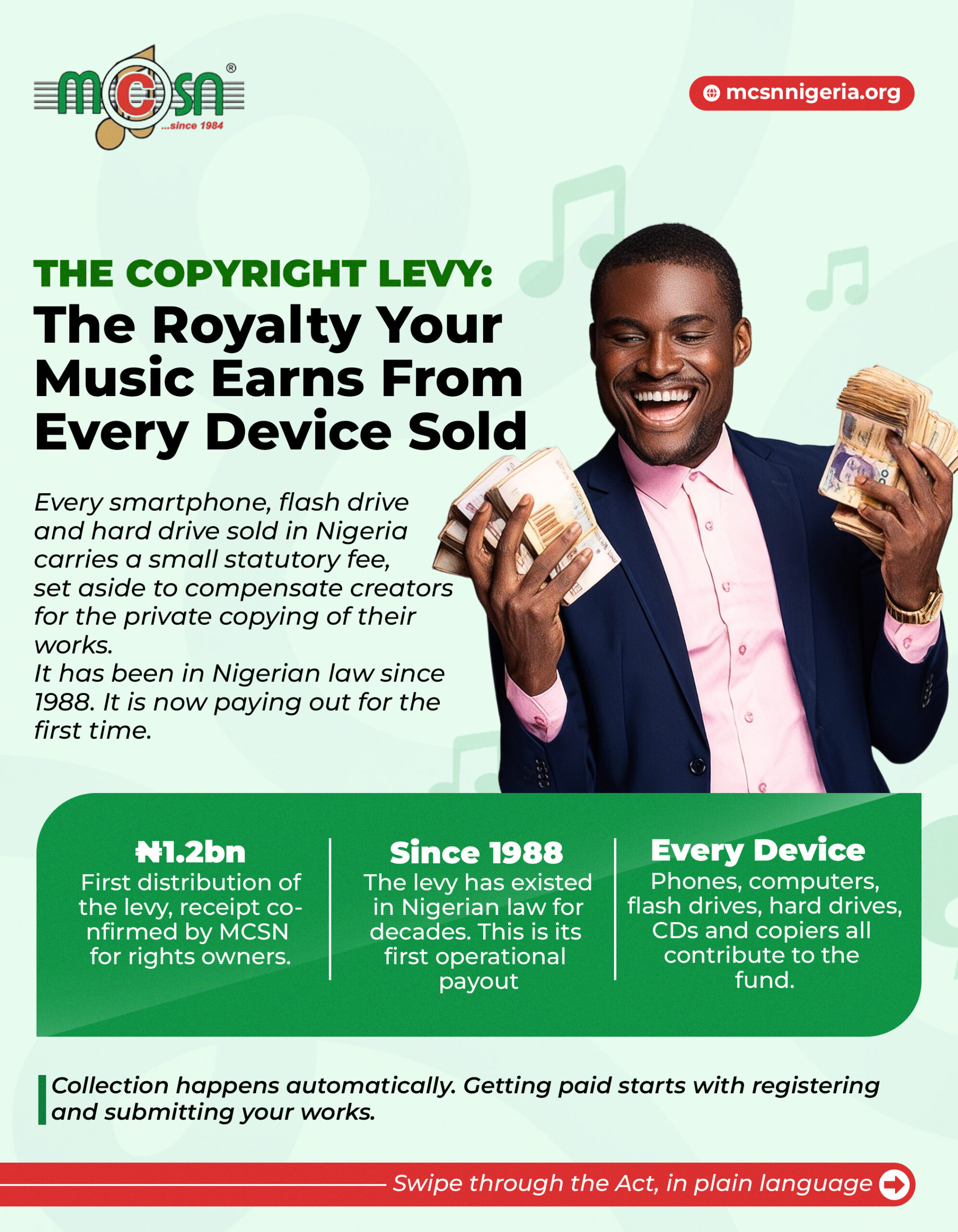
6. NCC administers the copyright levy
Section 89 of the Copyright Act 2022 provides for a copyright levy on materials and devices used to reproduce copyright works. The levy sat in Nigerian law from 1988 without ever being implemented.
In early 2026 that changed. The first tranche was processed and disbursed through the Nigerian Copyright Commission, with MCSN confirming receipt of ₦1,205,956,580.20 for musical works and sound recordings.
The division of labour is the same as everywhere else in this article. The Commission collects and disburses. MCSN verifies, documents and distributes to rights owners.
7. NCC educates the public and represents Nigeria abroad
The Commission runs enlightenment campaigns, workshops and training through the Nigerian Copyright Academy. Businesses gain from this as much as creators do, because a company that understands what the law requires will usually go and get a licence quietly, rather than wait for enforcement officers to explain it.
It also monitors Nigeria’s position under international copyright treaties, advises government on conventions, and represents the country at bodies such as WIPO. That advisory thread runs from the Copyright Decree of 1970, through the 1988 Act and its amendments, to the Copyright Act 2022 we operate under today.
What the NCC Does Not Do
The Commission does not:
- Pay you royalties: It is a regulator, not a collecting society. It does not track your radio spins or your streams.
- Issue music licences to businesses: Your hotel, radio station, lounge or streaming platform does not get a music licence from the Commission. It gets one from MCSN.
- Negotiate licence rates for your catalogue: Tariff negotiation is CMO and rights owner territory.
- Create your copyright: Registration on NCeRS is evidence of your claim, not the source of your rights.
- Act as your lawyer in civil disputes: It can investigate, mediate and prosecute crimes. It does not run your private breach of contract case against a label.
- Manage your catalogue data: Nobody at the Commission is matching your ISRCs to a broadcaster’s usage log.
Every item on that list is either a CMO function or a private legal matter.
How NCC Approval Powers MCSN
Everything the Commission does on the regulatory side unlocks something MCSN does on the practical side.
- The NCC enforces the Copyright Act: So an MCSN licence carries the weight of federal law, and ignoring it has consequences.
- The NCC approves CMOs: So MCSN can lawfully collect royalties on your behalf, something no unapproved body in Nigeria is permitted to do.
- The NCC regulates copyright operations: So MCSN can represent creators nationwide under one consistent set of rules, instead of a patchwork.
- The NCC’s approval gives MCSN legal standing: So MCSN can enforce its licences and take infringers to court as the recognised CMO for music.
- The NCC anchors the system in law: MCSN’s reciprocal agreements with societies abroad are credible, and royalties earned on your music overseas can find their way home.
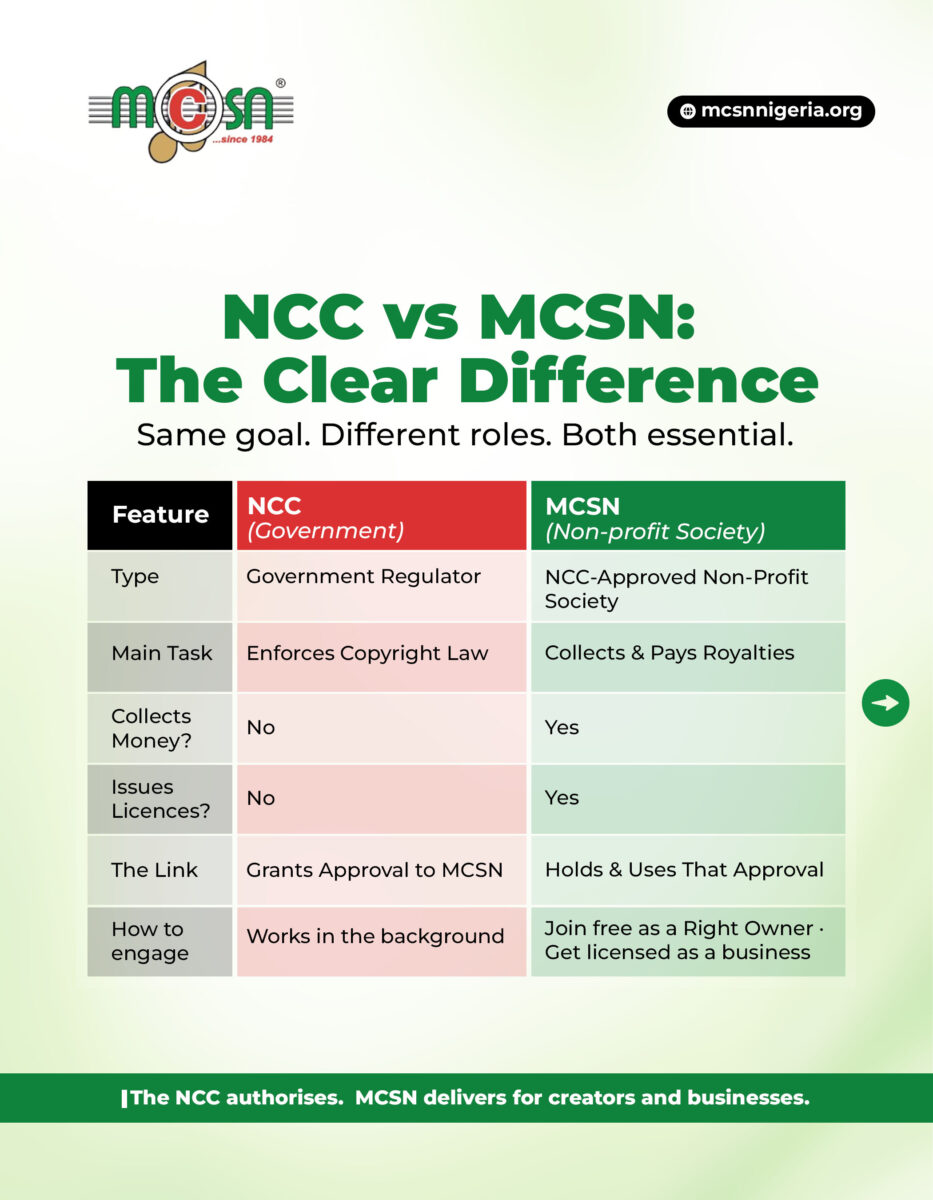
NCC vs MCSN: The Clear Difference
Same goal, different roles. The easiest way to understand the difference is to look at what each organisation is responsible for:
| Area | NCC | MCSN |
|---|---|---|
| What it is | A federal government agency responsible for copyright administration in Nigeria. | An approved Collective Management Organisation (CMO) representing music rights holders. |
| Legal basis | Established under the Copyright Act 2022. | Approved by the NCC under Section 88 of the Copyright Act 2022. |
| What it covers | All major categories of copyright, including music, films, books, software and artistic works. | Musical works and sound recordings within its approved mandate. |
| Core role | Regulates and administers the copyright system, supports enforcement and oversees CMOs. | Licenses music, monitors usage, collects licence fees and distributes royalties to rights holders. |
| Money flow | Does not operate as a music royalty collection body. | Collects licence fees from music users and distributes royalties to entitled rights holders. |
| Enforcement | Has statutory enforcement powers under copyright law, including investigation and anti-piracy actions. | Enforces the rights it manages, including taking action against unauthorised use and licensing breaches. |
| Relationship | Regulates and supervises approved CMOs. | Operates within the regulatory framework established by the NCC. |
| When you need it | For copyright administration, piracy complaints, regulatory matters and issues within its statutory mandate. | To manage your music rights collectively, receive royalties, or obtain a licence to use music represented by MCSN. |
MCSN or NCC: Who Do I Call? Six Real Situations
| Situation | Who to contact? | Why? |
|---|---|---|
| I run a lounge in Ikeja and play music every night. | MCSN | You need the appropriate music licence. |
| I want official evidence of my 2024 beat. | NCC | Register/notify the work through NCeRS as evidence of your claim. |
| A pirate site is streaming my whole album for free. | NCC + MCSN | Report the infringement to the NCC and notify MCSN for rights-management and enforcement purposes. |
| My song has played on radio for months but I have earned nothing. | MCSN | Check your membership, work registration and royalty records. |
| A brand used my song in a TV advert without permission. | MCSN + NCC | MCSN can address the rights issue; the NCC may be relevant for dispute resolution or other statutory remedies. |
| A hotel refuses to licence the music it plays. | MCSN | MCSN handles licensing and enforcement of the rights it manages. Persistent infringement may also involve the NCC. |
Three Myths Worth Killing
| Myth | Reality |
|---|---|
| “If I don’t register with the NCC, I don’t own my song.” | False. Copyright arises automatically when an original work is created. Registration provides evidence; it does not create ownership. |
| “I registered with the NCC, so my royalties will start coming.” | False. Copyright notification is not CMO membership and does not automatically generate royalty payments. Your works and rights must be properly documented with the relevant CMO. |
| “The NCC and MCSN are rivals.” | False. They have different roles. The NCC regulates and supervises the CMO system; MCSN manages music rights within that framework. |