
One play of one song can generate more than one payment, each owed to a different person. Most Nigerian creators collect only one of them, or none.
Picture this: A producer builds a beat. A songwriter writes the lyrics and melody. A singer records the vocals. A label or publisher handles the catalogue. The song drops. It gets radio airplay across Lagos, Abuja and Port Harcourt. It streams on DSPs. It plays in clubs, hotels and malls. A Nollywood production or brand later wants it for a scene or commercial. That single song creates multiple royalty streams. Yet a large share of that money never reaches the people who made it — not because it was never generated, but because many creators do not fully understand the different types of royalties, who owns them, or how to claim them through Nigeria’s approved Collective Management Organisation. This guide explains the four main types of music royalties that MCSN administers, who earns each one, what triggers payment, and how registering with MCSN puts the system to work for you.What Are Music Royalties?
Music royalties are payments owed to rights holders whenever their work is used commercially. Any time a song is played, broadcast, streamed, reproduced or licensed, the people who own it are legally entitled to be paid. They are not tips and they are not gifts. They are mandatory payments that the law requires music users to make to music owners. What has always been missing for many Nigerian creators is not the entitlement. It is the pipeline and that is what a Collective Management Organisation exists to provide.The Two Assets Inside Every Song
Every recorded song contains two distinct legal assets:- The musical work (composition): the melody, lyrics, harmony and structure. This belongs to songwriters, composers, lyricists and publishers.
- The sound recording (master): the specific recorded version that left the studio. This belongs to recording artists, performers, producers and record labels.
The Royalties MCSN Administers
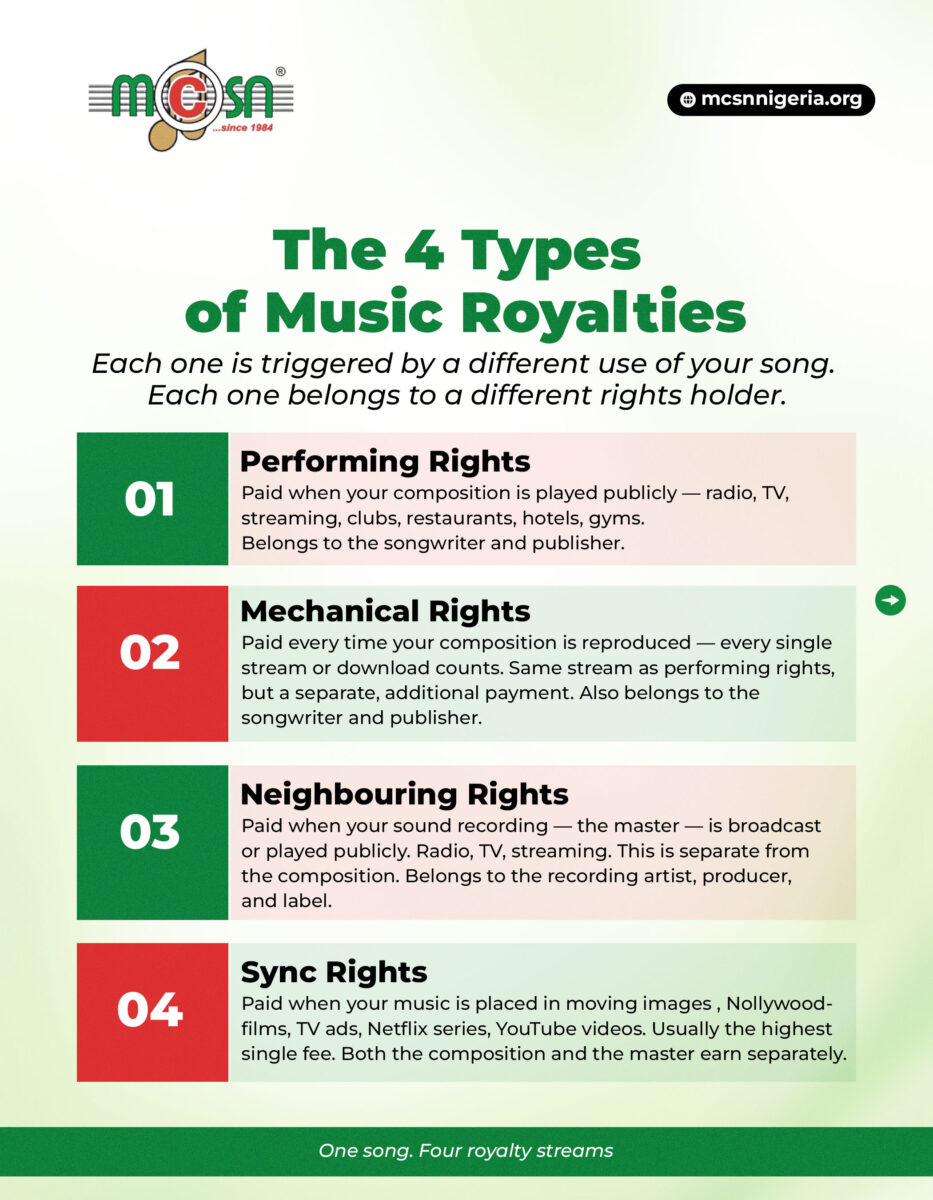
Each royalty is triggered by a specific kind of use and belongs to a specific set of people.1. Performing Rights: when your composition is played in public
Performing rights are triggered when a musical composition, the melody and lyrics, is performed or communicated to the public. “Public” covers far more than a concert. It includes a song played on radio or television, streamed online, or played in restaurants, hotel lobbies, gyms, shops and other commercial spaces. What it is: Payment for the public performance or communication of a composition. What triggers it: Radio and television broadcasts, live concerts and events, music played in public venues (hotels, restaurants, clubs, gyms, shopping malls, transport), and streams on digital platforms. Who earns it: Composers, songwriters, lyricists and music publishers; the owners of the composition. Who pays: Licensed broadcasters, venues, event organisers and platforms. MCSN issues the licences and collects the fees. How MCSN handles it: Stations and platforms submit usage logs and cue sheets. MCSN matches the plays to registered works and distributes the royalties to the correct rights holders. Under the current log-based distribution model, payments are tied to verified usage data rather than estimates. Performing rights are often the largest and most consistent stream for active songwriters whose works receive regular airplay or public use.2. Mechanical Rights: when your composition is reproduced
A mechanical royalty is generated whenever a composition is reproduced; copied from one format into another. The name is a relic from the days when music was mechanically pressed onto cylinders and vinyl, but the concept is more relevant now than ever, because in the digital age every stream is a reproduction. Here is the part most people miss: mechanical rights and performing rights are two different royalties, even when one action triggers both. When somebody streams your song, a performing right royalty is generated for the public communication of the song, and a mechanical royalty is generated at the same moment for the digital reproduction of your lyrics and melody. What it is: Payment for the reproduction (copying) of a composition. What triggers it: Physical formats (CDs, vinyl), digital downloads, ringtones, and most importantly today, every stream on platforms such as Boomplay, Spotify, Apple Music and Audiomack. Each stream creates a digital copy of the composition. Who earns it: The same people who own the composition (songwriters, composers and publishers). Who pays: Streaming platforms, download stores and physical manufacturers, through licences administered by MCSN (and through reciprocal arrangements internationally). Important distinction: A single stream usually generates both a performing right royalty and a mechanical royalty. They are separate payments for different rights in the same composition. MCSN licenses digital services operating in Nigeria and ensures the mechanical share reaches registered writers and publishers.3. Neighbouring Rights (Related Rights): when your recording is played
Everything above belongs to the composition; the songwriter and publisher. Neighbouring rights, also called related rights, belong to the other half of the song: the sound recording (the master). These royalties go to the people who created the recorded version, whether or not they wrote a word of it. This is the stream Nigerian performers and producers have historically lost the most money on, because many never knew it existed as a separate payment. What it is: Payment for the public use of a sound recording (the master), separate from the composition. What triggers it: The same broadcasts, public performances and streams that generate performing rights, but this royalty belongs to the people who created and own the recording. Who earns it: Recording artists, session performers, producers and record labels. Who pays: The same licensed users (broadcasters, venues, platforms). One licence fee can generate both a performing right payment (to the writers) and a neighbouring right payment (to the performers and producers). You do not need to have written the song to earn neighbouring rights. If your voice, instrument or production appears on the master and you are properly registered, you are entitled to a share when that specific recording is played publicly. MCSN administers neighbouring rights alongside composition rights, so artists and producers can collect from the same system.4. Synchronisation (Sync) Rights: when your music meets moving images
Synchronisation, or sync, is triggered when music is paired with visuals, a Nollywood film, a television advert, a Netflix series, a YouTube video, or a brand campaign. Sync is often the largest single payment a song ever earns, and the most overlooked by independent Nigerian creators. It works differently from the other three. Rather than being collected through broad licences, a sync licence is usually a one-off fee negotiated upfront for a specific project. Because both the composition and the master are used, two separate sync fees are typically paid. One thing worth being blunt about: buying a song is not the same as buying the right to synchronise it. A brand cannot download your track, place it under a commercial, and treat the download as permission. The rights have to be cleared. What it is: Payment for the use of music with moving images. What triggers it: Nollywood films and series, television programmes, commercials and advertisements, video games, corporate videos, documentaries, and online video content. Who earns it: Both sides of the song. The composition owners (writers and publishers) and the master owners (artists and labels) each receive separate sync fees in a typical clearance. How it works: Sync is usually a negotiated, one-time (or project-based) licence rather than a blanket collection. Because both the composition and the master must be cleared, productions prefer tracks that are already registered and easy to license. MCSN facilitates sync clearances for registered works. When a production company wants a Nigerian song, having the work properly registered with MCSN makes the process faster, safer and more likely to result in a deal that fairly compensates the rights holders.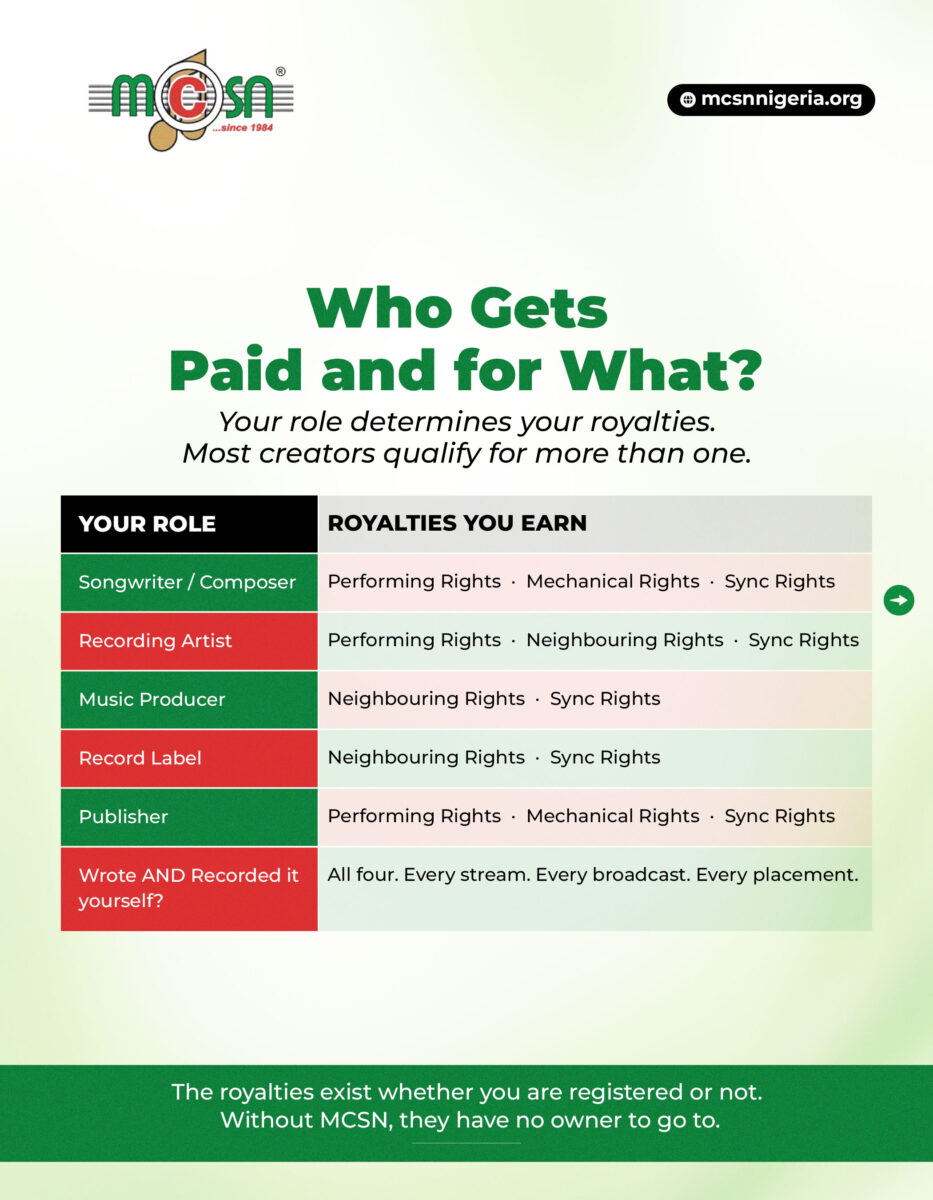
Who Earns What: Royalties by Role
| Role | Performing | Mechanical | Neighbouring | Sync |
|---|---|---|---|---|
| Songwriter / Composer | Yes | Yes | No* | Yes (composition) |
| Lyricist / Author | Yes | Yes | No* | Yes (composition) |
| Music Publisher | Yes | Yes | No* | Yes (composition) |
| Recording Artist / Performer | No* | No* | Yes | Yes (master) |
| Producer | Sometimes** | Sometimes** | Yes | Yes (master) |
| Record Label | No* | No* | Yes | Yes (master) |
| Wrote and recorded it | Yes | Yes | Yes | Yes (both) |
One Song, Many Uses: Where Each Royalty Shows Up
The four types are simple enough on paper. It is in real situations that creators lose track of which right is being used, and therefore which money they should be chasing.Streaming
Streaming confuses people because more than one right is used at once. A single stream engages the composition and the sound recording, so it can generate a performing right, a mechanical right and a neighbouring right simultaneously, moving through different channels depending on the platform, the territory and the agreements in place. This is also why a distributor and a CMO are not the same thing, and confusing them is one of the most expensive mistakes an independent artist can make. A distributor gets your recording onto platforms and collects the money owed for the exploitation of that recording. A CMO administers the collective rights in its mandate and collects from licensed uses of the music it represents. They cover different rights and they pay different money. Do not assume the money from your distributor is every royalty your music generates. If you wrote, performed and recorded your own song, there are several rights and several revenue streams attached to that one track, and a distributor statement shows you only part of the picture.Radio and television
When a station plays your record, that single broadcast uses both assets at once. The songwriter and publisher earn a performing right royalty on the composition. The recording artist, performers, producer and label earn a neighbouring right royalty on the master. Two payments. Two sets of recipients. One play. Licensees report the works they use, we match those reports against our repertoire, and royalties are calculated from there. So radio airplay is not merely publicity. For a properly registered work, it is a royalty-generating use.Live performance
Performing your song at a concert, festival or public event triggers performing rights in the underlying musical work. And if another artist performs your song, your rights in the composition do not disappear. The performer has rights connected to their own performance, but your copyright in the composition remains yours unless you have transferred or licensed it. That is one reason songwriters should pay attention to their publishing interests even when they are not the person standing on stage.Clubs, hotels, restaurants and gyms
The commercial context is what matters here. A DJ playing music in a club is not the same as someone listening privately through headphones. A hotel playing music throughout its premises is not the same as a guest listening in their room. A restaurant using music as part of the customer experience is not the same as a person playing music at home. MCSN licenses venues, hospitality businesses, broadcasters and other organisations that use music publicly. The logic is straightforward: if a business is commercially benefiting from copyrighted music, the rights holders should have a mechanism through which that use is licensed and paid for.Film, television and advertising
This is where sync becomes central. A producer who wants your music in a film needs permission for the rights involved, and the same applies to a brand putting your song behind a commercial. Depending on who owns what, MCSN can administer the applicable rights and facilitate the clearance. What a production cannot do is skip the step.Why Registration Is the Whole Thing
Distribution needs two things: the money, and reliable information about what was used. We match reported usage against the works and rights holders in our repertoire, then calculate what each person is owed. Registration is not paperwork for its own sake. It is what connects your song to its usage, your usage to your rights, and your rights to your royalty. If a work is missing from the system, incorrectly registered, carrying incomplete ownership information or conflicting metadata, the usage cannot be matched to you. That matters most where there are several writers, producers, publishers or owners on one track.What to know before you submit a work
- Who wrote it
- Who composed it
- Who owns the publishing rights
- The agreed ownership shares
- Who owns or controls the sound recording
- Who performed on the recording
- The correct title and artist information
- Any other relevant metadata, including ISRC and ISWC codes where you have them
How MCSN Collects and Pays: The Royalty Chain
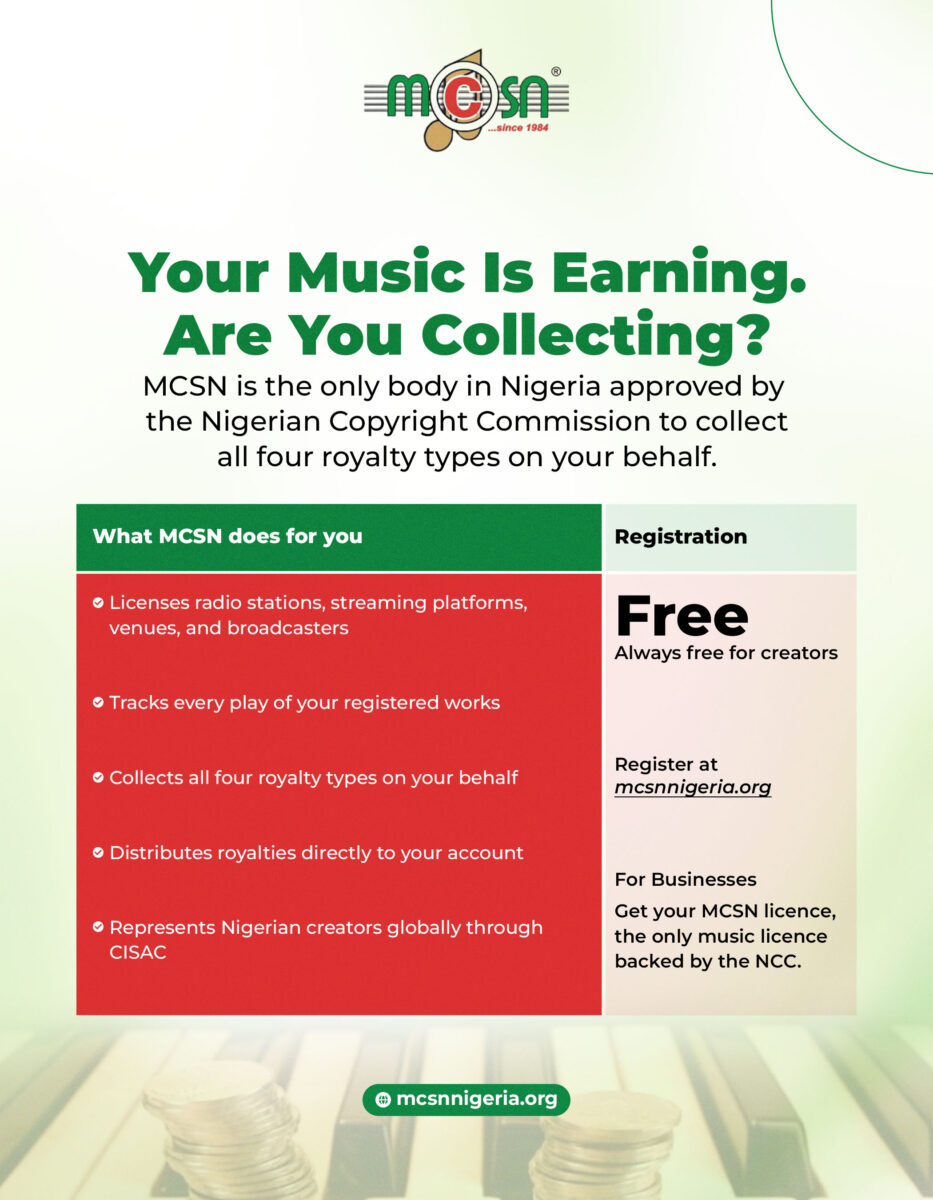
MCSN is the organisation approved by the Nigerian Copyright Commission to collect these royalties for musical works and sound recordings. We sit between music users and the rights holders whose music they use.- Rights holders register their works and their rights.
- We licence music users: broadcasters, venues, businesses, event organisers and digital platforms.
- Music users report usage, or generate usage data through the platforms they operate.
- We monitor and verify what was played, where and how often.
- We collect the licence fees and royalties due.
- Usage is matched to the relevant works and rights holders in the repertoire.
- Royalties are calculated and distributed, paid into the account each member provides at registration, with statements showing what played, where and at what rate.
Royalties Earned Outside Nigeria
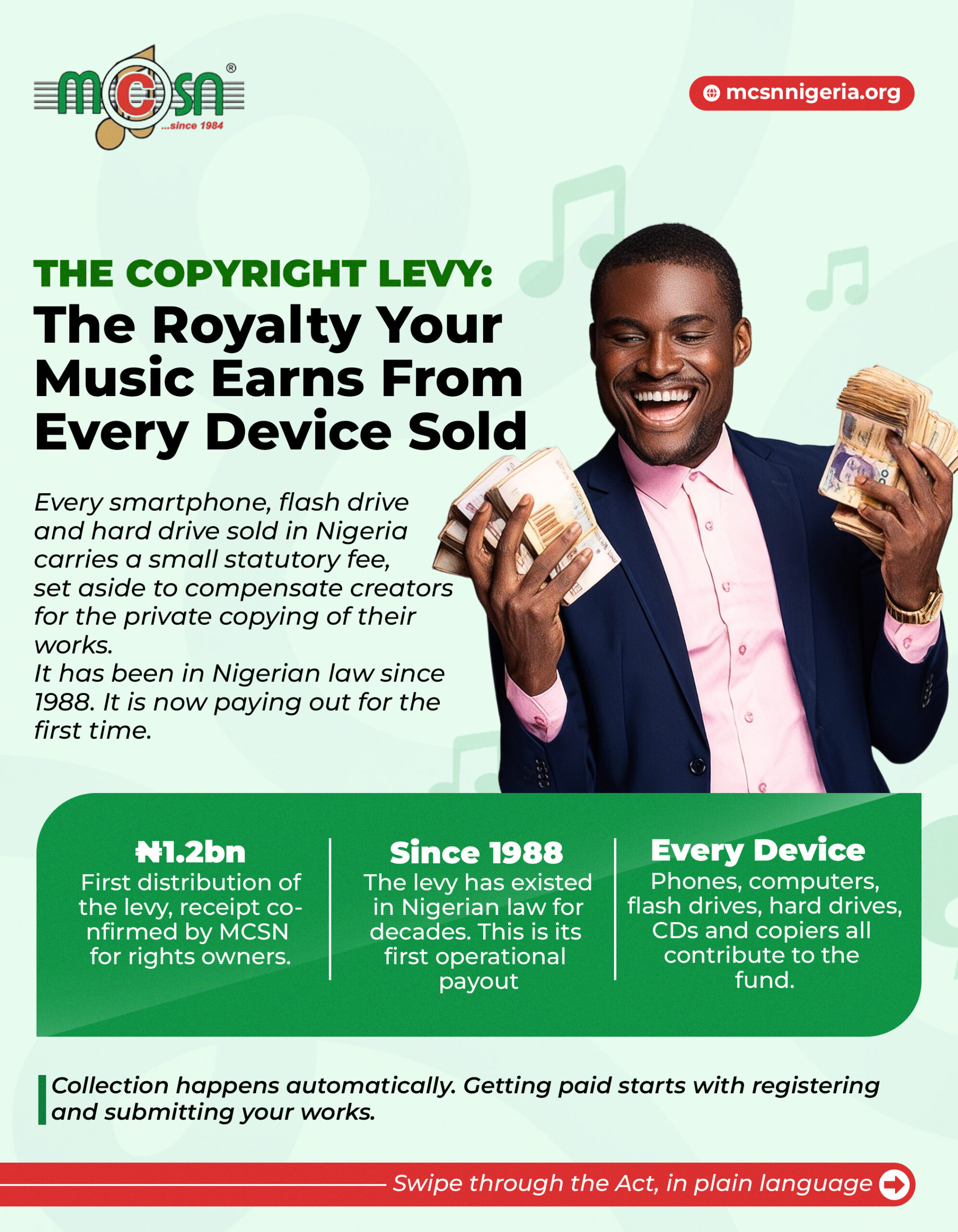
Your music does not stop earning because it crosses a border. A Nigerian song can be played on radio in Ghana, used in a venue in the United Kingdom, broadcast in South Africa or streamed anywhere. Collecting those royalties country by country would be impossible for almost any individual creator. MCSN works with international societies through reciprocal arrangements, so that royalties generated by the use of represented music in other territories can flow back to the rights holders here. The same principle runs in reverse for foreign music used in Nigeria. This is one of the strongest arguments for collective management. Your rights can travel even when you cannot.The Biggest Mistake Creators Make
Many creators think: I released my song, so I should be receiving royalties. Releasing a song is only the beginning. You also need to know what rights you own, who administers them, where your music is being used, and whether your work is registered and identifiable. A song can have millions of streams and still have a rights management problem. A songwriter can write a hit for another artist and collect nothing on the composition because the writer information was never properly documented. A recording artist can have a widely played record and miss the neighbouring rights because the recording ownership was never captured. In each case the music is generating money. The problem is that the system cannot connect that money to the person entitled to it.